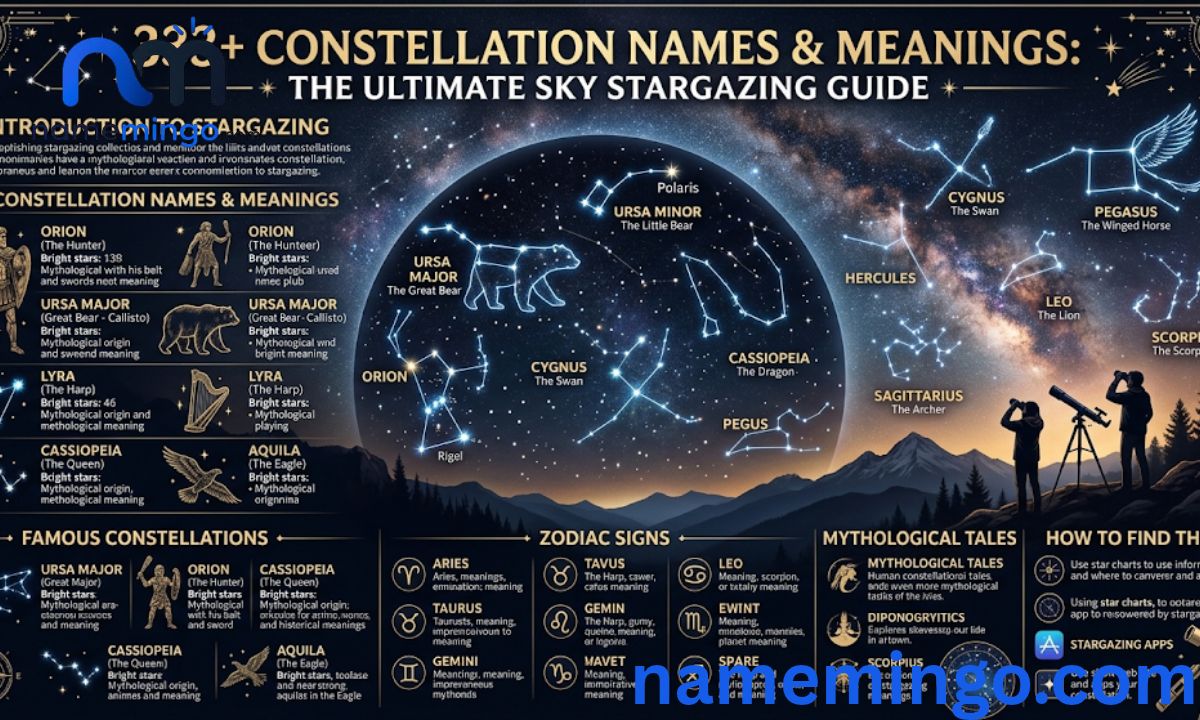
Look up on a clear night and you will see a sky full of stars. Long ago, people joined these stars with imaginary lines. They made shapes of heroes, animals, and gods. These shapes are called constellations.
Each constellation has a name and a story. Orion is the hunter, and Ursa Major is the great bear. Leo is the lion, and Scorpius is the scorpion. Many names come from old Greek and Roman myths, and each one carries a meaning.
This guide will help you start stargazing. You will learn the names, the stories, and how to find them. Find a dark spot and let your eyes adjust. Then enjoy the sky.
Constellations Names and Meanings
Every constellation name has a meaning. Most come from old myths, animals, and tools. Here are seven major ones.
- Orion: The Hunter
- Ursa Major: The Great Bear
- Leo: The Lion
- Scorpius: The Scorpion
- Cassiopeia: The Vain Queen
- Cygnus: The Swan
- Gemini: The Twins
Constellations Names and Pictures
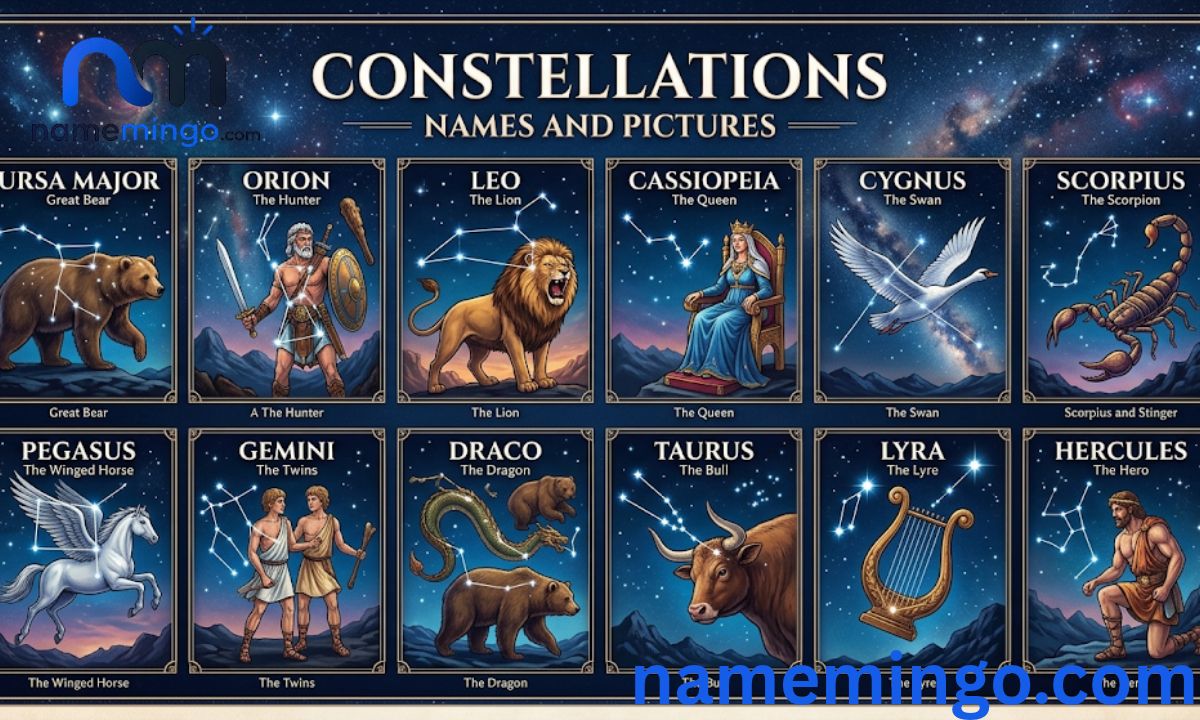
A constellation is a picture drawn in the sky. You connect the dots between bright stars. Here are seven shapes that are easy to spot.
- Orion: Three stars in a row make his belt.
- Ursa Major: Its seven stars form the Big Dipper.
- Cassiopeia: Five stars make a bold W or M.
- Cygnus: A bright cross, also called the Northern Cross.
- Scorpius: A curved tail with a red star for a heart.
- Lyra: A small, tidy parallelogram.
- Leo: A backward question mark forms the lion’s head.
Constellation Names A to Z
Sorting names by letter makes them easy to learn. You can work through them one by one. Here are seven major names in alphabetical order.
- Andromeda
- Cassiopeia
- Cygnus
- Leo
- Orion
- Scorpius
- Ursa Major
88 Constellations Names and Pictures
The sky is split into 88 official regions. Every star belongs to one of them. Some are best seen in the north, and some in the south.
- Ursa Minor: The Little Bear, home of the North Star
- Draco: The Dragon, winding around the north pole
- Pegasus: The Winged Horse
- Taurus: The Bull
- Crux: The Southern Cross
- Centaurus: The Centaur
- Sagittarius: The Archer
How Did the Constellation Get Its Name
Ancient people named the sky long ago. They saw animals, heroes, and gods in the stars. Later, Greek and Roman writers gave us most names we use today. Here are seven examples and where they come from.
- Orion: Named for a hunter in Greek myth.
- Hercules: Named for the mighty Greek hero.
- Perseus: Named for the hero who beat Medusa.
- Aquarius: Named for the water bearer.
- Pegasus: Named for the flying horse.
- Telescopium: A newer name, made after the telescope was invented.
- Crux: A newer name, set by explorers in the south.
How Did Leo the Constellation Get Its Name
Leo means “lion” in Latin. People in many lands saw a lion in these stars. The Greeks linked it to a fierce lion killed by Hercules. These seven stars are part of Leo.
- Regulus: “Little King,” the brightest star
- Denebola: “Tail of the Lion”
- Algieba: “The Forehead”
- Zosma: “The Girdle”
- Adhafera: “The Lock of Hair”
- Rasalas: “Head of the Lion”
- Algenubi: “The Southern One”
Why Choose a Constellation Name?
A constellation name feels special and rare. It ties your child, pet, or project to the night sky. It also comes with a story and a meaning. Here are seven popular choices.
- Orion: Strong and brave
- Lyra: Musical and gentle
- Leo: Bold and proud
- Vega: Bright and shining
- Phoenix: Reborn and hopeful
- Andromeda: Graceful and strong
- Carina: Steady and sure
Boy Constellation Names (Strong and Heroic)
These names sound strong and brave. Many come from heroes and fierce animals. They suit a boy with a big spirit.
- Orion: The great hunter
- Leo: The lion
- Draco (DRAY ko): The dragon
- Hercules (HER kyoo leez): The mighty hero
- Perseus (PUR see us): The monster slayer
- Phoenix (FEE nix): The bird that rises from fire
- Lupus (LOO pus): The wolf
- Cygnus (SIG nus): The swan
- Bootes (boo OH teez): The herdsman
- Corvus (KOR vus): The crow
Girl Constellation Names (Elegant and Celestial)
These names sound soft, graceful, and bright. Many come from queens, princesses, and shining stars. They suit a girl with a gentle glow.
- Lyra (LEER ah): The harp
- Cassiopeia (kass ee oh PEE ah): The queen
- Andromeda (an DROM eh dah): The chained princess
- Vega (VAY gah): The falling eagle, a very bright star
- Ara (AIR ah): The altar
- Norma (NOR mah): The carpenter’s square
- Carina (kah REE nah): The keel of a ship
- Columba (koh LUM bah): The dove
- Delphinus (del FY nus): The dolphin
- Virgo (VER go): The maiden
Unisex Constellation Names (For Anyone)
These names fit any child. They sound calm, modern, and fresh. Many are simple objects or symbols.
- Gemini (JEM in eye): The twins
- Phoenix (FEE nix): The firebird
- Libra (LEE brah): The scales
- Hydra (HY drah): The water snake
- Scutum (SKYOO tum): The shield
- Pyxis (PIK sis): The compass
- Mensa (MEN sah): The table mountain
- Pictor (PIK tor): The painter
- Antlia (ANT lee ah): The air pump
- Caelum (SY lum): The chisel
Unique Constellation Names (Rare and Unusual)
These names are not common at all. They are great if you want something different. Most are faint, southern constellations.
- Chamaeleon (kuh MEE lee un): The chameleon
- Dorado (doh RAH doh): The dolphinfish
- Horologium (hor oh LO jee um): The pendulum clock
- Musca (MUSS kah): The fly
- Octans (OK tans): The octant, a navigation tool
- Reticulum (reh TIK yoo lum): The small net
Sculptor (SKULP tor)
Sculptor is a faint southern constellation. It is named for an artist’s studio. It is hard to see, so it suits people who love hidden things. Here are seven names linked to it.
- Sculptor: The artist’s workshop
- Pictor: The painter’s easel
- Caelum: The engraving chisel
- Fornax: The furnace
- Horologium: The pendulum clock
- Reticulum: The small net
- Antlia: The air pump
Sextans (SEX tans)
Sextans is a small, dim constellation near Leo. It is named for a tool sailors used to find their way. It honors the age of exploration. Here are seven tools and measuring names from the sky.
- Sextans: The sextant
- Octans: The octant
- Norma: The carpenter’s square
- Circinus: The drawing compass
- Pyxis: The mariner’s compass
- Libra: The scales
- Telescopium: The telescope
Telescopium (tell eh SKO pee um)
Telescopium is a faint southern constellation. It was named in the 1750s to honor the telescope. It reminds us that science shaped the sky. Here are seven science and tool names.
- Telescopium: The telescope
- Microscopium: The microscope
- Horologium: The pendulum clock
- Antlia: The air pump
- Fornax: The chemical furnace
- Sextans: The sextant
- Reticulum: The eyepiece grid
Triangulum (try ANG gyoo lum)
Triangulum is a small, neat triangle of stars. It is one of the oldest named shapes in the sky. It is easy to find near Andromeda. Here are seven shape and symbol names.
- Triangulum: The triangle
- Triangulum Australe: The southern triangle
- Crux: The cross
- Quadrans Muralis: The old wall quadrant
- Norma: The square
- Scutum: The shield
- Corona Australis: The southern crown
Funny Constellation Names (For Pets & Jokes)
Some constellation names are cute and silly. They fit a pet or a joke. They bring a smile with every story. Here are seven playful picks.
- Musca: The fly
- Lynx: The wildcat
- Vulpecula: The little fox
- Lacerta: The lizard
- Mensa: The table mountain
- Antlia: The air pump
- Grus: The crane
Canes Venatici (KAY neez ven AT ih see)
Canes Venatici means “the hunting dogs.” It sits below the Big Dipper’s handle. The Greeks and Romans pictured two dogs held by a herdsman. Here are seven dog and hunt names.
- Canes Venatici: The hunting dogs
- Canis Major: The great dog
- Canis Minor: The little dog
- Lupus: The wolf
- Bootes: The herdsman
- Orion: The hunter
- Lepus: The hare
Leo Minor (LEE oh MY nor)
Leo Minor means “the little lion.” It is small and faint. It sits just above Leo, the great lion. Here are seven small and “minor” names.
- Leo Minor: The little lion
- Ursa Minor: The little bear
- Canis Minor: The little dog
- Equuleus: The little horse
- Triangulum: The small triangle
- Sagitta: The arrow
- Vulpecula: The little fox
Lynx (LINKS)
Lynx is a dim northern constellation. It was named because you need sharp eyes, like a lynx, to see it. It is a fun name for a quick, clever pet. Here are seven wild animal names.
- Lynx: The wildcat
- Lupus: The wolf
- Leo: The lion
- Ursa Major: The great bear
- Taurus: The bull
- Aquila: The eagle
- Cygnus: The swan
Monoceros (moh NOSS er os)
Monoceros means “the unicorn.” It sits in a busy part of the winter sky. It holds nebulae and bright star clouds. Here are seven magical creature names.
- Monoceros: The unicorn
- Draco: The dragon
- Pegasus: The winged horse
- Phoenix: The firebird
- Hydra: The sea serpent
- Centaurus: The centaur
- Capricornus: The sea goat
Vulpecula (vul PEK yoo lah)
Vulpecula means “the little fox.” It sits in the summer sky near Cygnus. It holds the famous Dumbbell Nebula. Here are seven small animal names.
- Vulpecula: The little fox
- Lacerta: The lizard
- Musca: The fly
- Columba: The dove
- Delphinus: The dolphin
- Lepus: The hare
- Sagitta: The arrow
Fornax (FOR nax)
Fornax is a faint southern constellation. Its name means “furnace.” It was named in the 1750s. Here are seven names about fire and heat.
- Fornax: The furnace
- Phoenix: The firebird
- Ara: The altar
- Corona Borealis: The northern crown
- Sol: The sun
- Nova: The new bright star
- Regulus: The little king
Also Read This : 418+ Best Medical Team Names: Clever, Funny, and Strong Ideas
Grus (GROOSE)
Grus means “the crane.” It is a tall bird of the southern sky. Its stars form a long, graceful neck. Here are seven bird names.
- Grus: The crane
- Aquila: The eagle
- Cygnus: The swan
- Corvus: The crow
- Columba: The dove
- Pavo: The peacock
- Tucana: The toucan
Lacerta (lah SIR tah)
Lacerta means “the lizard.” It is a small zigzag of stars. It sits between Cygnus and Andromeda. Here are seven reptile and water names.
- Lacerta: The lizard
- Chamaeleon: The chameleon
- Draco: The dragon
- Hydra: The water snake
- Serpens: The serpent
- Volans: The flying fish
- Dorado: The dolphinfish
Trendy Modern Constellation Names
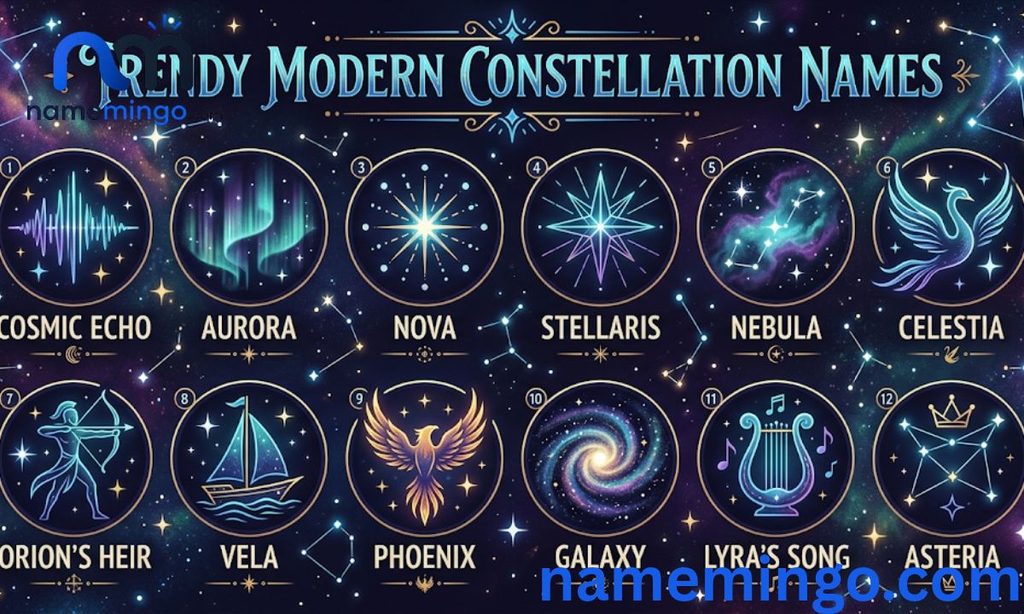
These names feel soft, fresh, and stylish. Many sound like real baby names. They are short, bright, and easy to say. Here are seven trendy picks.
- Nova: A new star
- Elara: A moon of Jupiter
- Titan: A giant moon of Saturn
- Cosmo: The universe
- Stella: Star
- Aster: Star flower
- Cielo: Sky
Nova (NO vah)
Nova is a Latin word for “new.” It names a star that flares up suddenly. It sounds modern and strong. Here are seven bright and new names.
- Nova: The new star
- Vega: The bright falling eagle
- Sirius: The scorching star
- Rigel: The hunter’s foot
- Altair: The flying eagle
- Polaris: The pole star
- Capella: The little goat
Elara (eh LAR ah)
Elara is a moon of Jupiter. It is named for a lover of Zeus in Greek myth. It sounds gentle and rare. Here are seven moon and planet names.
- Elara: Moon of Jupiter
- Io: Moon of Jupiter
- Europa: Moon of Jupiter
- Callisto: Moon of Jupiter
- Luna: Our moon
- Rhea: Moon of Saturn
- Selene: Greek moon goddess
Titan (TY tan)
Titan is the largest moon of Saturn. In myth, the Titans were giant gods. The name feels huge and bold. Here are seven giant and mighty names.
- Titan: Saturn’s giant moon
- Atlas: A titan who held up the sky
- Hyperion: A titan of light
- Cronus: Father of the gods
- Rhea: A titan mother
- Hercules: The mighty hero
- Orion: The giant hunter
Cosmo (KOZ mo)
Cosmo comes from “cosmos,” the Greek word for order and universe. It is playful and friendly. It fits a curious child or pet. Here are seven universe names.
- Cosmo: The universe
- Galaxy: The milky star band
- Orbit: The path around a star
- Comet: The long-haired star
- Astro: Star
- Zenith: The highest point in the sky
- Eclipse: When light is hidden
Stella (STEL ah)
Stella is the Latin word for “star.” It is classic and warm. It has been loved for many years. Here are seven star names.
- Stella: Star
- Astra: Of the stars
- Estelle: Star, in French
- Starla: Little star
- Sirius: The brightest star
- Vega: A shining star
- Polaris: The north star
Aster (ASS ter)
Aster means “star” in Greek. It is also a flower with star-shaped petals. It feels gentle and natural. Here are seven star and flower names.
- Aster: Star flower
- Astrid: Divinely beautiful
- Asteria: Greek goddess of stars
- Daisy: The day’s eye
- Lily: A pure white bloom
- Iris: The rainbow
- Flora: The flower goddess
Cielo (see EH lo)
Cielo means “sky” in Spanish and Italian. It sounds calm and open. It is a lovely name for anyone. Here are seven sky names.
- Cielo: Sky
- Celeste: Heavenly
- Azure: Clear blue sky
- Skye: The open sky
- Caelum: The heavens
- Aurora: The dawn
- Zephyr: The west wind
Fantasy Constellation Names (For Characters & Worlds)
Writers and gamers love these names. They sound like dragons, serpents, and ancient lands. They are perfect for characters and magic worlds. Here are seven fantasy picks.
- Serpens: The serpent
- Ophiuchus: The serpent bearer
- Aquila: The eagle
- Corona Borealis: The northern crown
- Centaurus: The centaur
- Cetus: The sea monster
- Pavo: The peacock
Serpens (SUR penz)
Serpens means “the serpent.” It is the only constellation split in two parts. The head and tail sit on either side of Ophiuchus. Here are seven snake and serpent names.
- Serpens: The serpent
- Serpens Caput: The serpent’s head
- Serpens Cauda: The serpent’s tail
- Hydra: The water snake
- Draco: The dragon
- Ophiuchus: The snake handler
- Cetus: The sea beast
Ophiuchus (off ee YOO kus)
Ophiuchus is the “serpent bearer.” He is shown holding a great snake. He is linked to a healer in Greek myth. Here are seven healer and wise names.
- Ophiuchus: The serpent bearer
- Asclepius: The god of healing
- Chiron: The wise centaur
- Hygieia: Goddess of health
- Apollo: God of light and healing
- Athena: Goddess of wisdom
- Merlin: The wise wizard
Aquila (uh KWIL ah)
Aquila means “the eagle.” It carried the thunderbolts of Zeus. It flies through the summer Milky Way. Here are seven sky bird names.
- Aquila: The eagle
- Altair: The flying eagle
- Cygnus: The swan
- Lyra: The harp
- Vega: The falling eagle
- Deneb: The tail of the swan
- Sagitta: The arrow
Corona Borealis (koh ROH nah bor ee AL is)
Corona Borealis means “the northern crown.” It is a small, bright half-circle. Legend says it is a gift from a god to a princess. Here are seven crown and royal names.
- Corona Borealis: The northern crown
- Corona Australis: The southern crown
- Cassiopeia: The queen
- Cepheus: The king
- Ariadne: The princess of Crete
- Regulus: The little king
- Andromeda: The princess
Centaurus (sen TOR us)
Centaurus is the centaur, half man and half horse. It is a large southern constellation. It holds the closest star system to the Sun. Here are seven half-beast names.
- Centaurus: The centaur
- Chiron: The wise centaur
- Sagittarius: The archer centaur
- Capricornus: The sea goat
- Pegasus: The winged horse
- Monoceros: The unicorn
- Lupus: The wolf
Cetus (SEE tus)
Cetus is the sea monster. In myth, it was sent to attack Andromeda. It is one of the largest constellations. Here are seven sea creature names.
- Cetus: The sea monster
- Delphinus: The dolphin
- Pisces: The fish
- Eridanus: The river
- Dorado: The dolphinfish
- Volans: The flying fish
- Hydrus: The lesser water snake
Pavo (PAH vo)
Pavo means “the peacock.” It is a southern bird with a bright blue star. It was named in the 1600s. Here are seven colorful names.
- Pavo: The peacock
- Tucana: The toucan
- Apus: The bird of paradise
- Indus: The Indian
- Azure: Bright blue
- Scarlet: Deep red
- Aurora: The glowing dawn
Volans (VO lans)
Volans means “the flying fish.” It sits in the far southern sky. It is small and faint. Here are seven names about flying and speed.
- Volans: The flying fish
- Pegasus: The flying horse
- Aquila: The soaring eagle
- Apus: The bird with no feet
- Sagitta: The arrow
- Phoenix: The rising firebird
- Comet: The streaking star
Also Read This : 400+ Best PS5 Username Ideas: Cool, Funny, & Gamertag Examples
Mythical & Historical Constellation Names
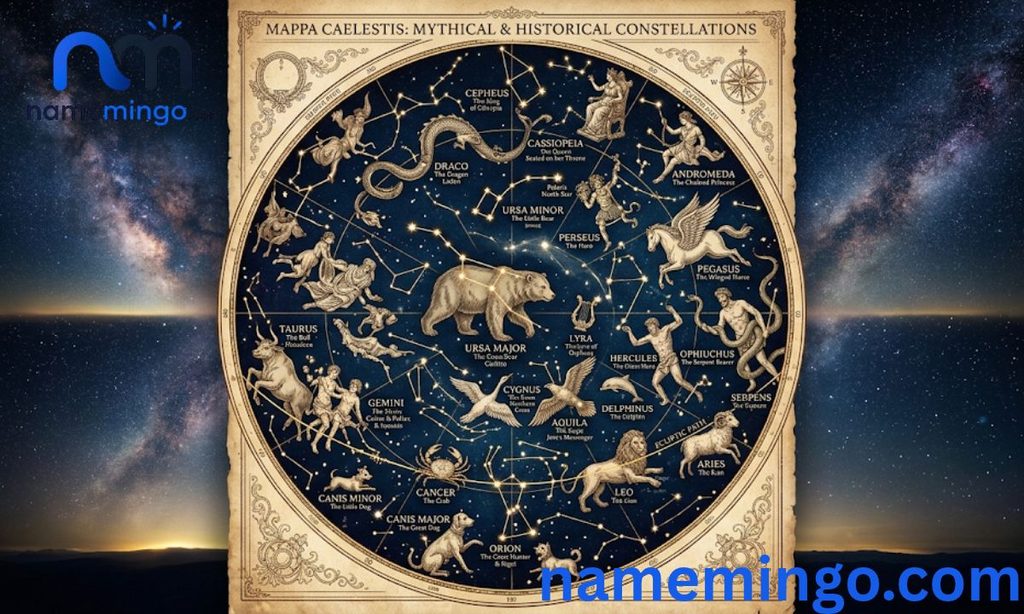
These names come from old Greek stories. Heroes, queens, and bears still shine above us. Each one holds a tale from long ago. Here are seven classic picks.
- Orion: The hunter
- Andromeda: The chained princess
- Cassiopeia: The vain queen
- Perseus: The hero
- Hercules: The strong hero
- Ursa Major: The great bear
- Ursa Minor: The little bear
Orion
Orion is a mighty hunter in Greek myth. His belt of three stars is easy to spot. He rules the winter sky. Here are seven stars inside him.
- Betelgeuse: The red shoulder star
- Rigel: The blue foot star
- Bellatrix: The female warrior
- Saiph: The sword of the giant
- Alnitak: The belt star
- Alnilam: The string of pearls
- Mintaka: The belt
Andromeda
Andromeda was a princess chained to a rock. The hero Perseus saved her. Her constellation holds a famous galaxy. Here are seven names from her story.
- Andromeda: The princess
- Perseus: Her rescuer
- Cassiopeia: Her mother
- Cepheus: Her father
- Cetus: The sea monster
- Pegasus: The winged horse
- Medusa: The gorgon
Cassiopeia
Cassiopeia was a proud queen. Her bold W shape is easy to find. She circles the north star all night. Here are seven royal story names.
- Cassiopeia: The queen
- Cepheus: The king
- Andromeda: The daughter
- Perseus: The hero
- Poseidon: The sea god
- Schedar: The breast
- Caph: The hand
Perseus (PUR see us)
Perseus was a Greek hero. He beat the gorgon Medusa. His stars sit near Cassiopeia. Here are seven names from his tale.
- Perseus: The hero
- Medusa: The gorgon
- Algol: The demon star
- Danae: His mother
- Athena: His helper
- Hermes: The winged messenger
- Pegasus: The winged horse
Hercules (HER kyoo leez)
Hercules was the strongest hero of Greece. He faced twelve great labors. His constellation holds a famous star cluster. Here are seven names from his labors.
- Hercules: The mighty hero
- Leo: The lion he beat
- Hydra: The many-headed snake
- Cancer: The crab
- Draco: The dragon guard
- Cygnus: The swan
- Lyra: The harp
Ursa Major (UR sah MAY jor)
Ursa Major means “the great bear.” It holds the Big Dipper. It is one of the best-known shapes in the sky. Here are seven star names in it.
- Dubhe: The bear
- Merak: The loin
- Phecda: The thigh
- Megrez: The root of the tail
- Alioth: The fat tail
- Mizar: The girdle
- Alkaid: The leader
Ursa Minor (UR sah MY nor)
Ursa Minor means “the little bear.” It holds the Little Dipper. Its tail star is Polaris, the North Star. Here are seven names for guiding stars.
- Ursa Minor: The little bear
- Polaris: The north star
- Kochab: The star
- Pherkad: The calf
- Yildun: The star
- Navigator: One who finds the way
- Orion: A famous guide star shape
Auriga (aw RY gah)
Auriga means “the charioteer.” It holds the bright star Capella. It rides high in the winter sky. Here are seven names for drivers and riders.
- Auriga: The charioteer
- Capella: The little goat
- Menkalinan: The shoulder of the rein holder
- Pegasus: The winged horse
- Bootes: The herdsman
- Sagittarius: The archer
- Centaurus: The centaur rider
Meaningful & Strong Constellation Names
These names carry deep meaning. Many are tools, symbols, and old crafts. They suit someone who values purpose and skill. Here are seven strong picks.
- Ara: The altar
- Crux: The cross
- Norma: The square
- Pyxis: The compass
- Antlia: The air pump
- Sculptor: The artist
- Fornax: The furnace
Ara (The Altar)
Ara is the altar where the gods swore oaths. It sits in the southern sky. It stands for promise and faith. Here are seven names about vows and faith.
- Ara: The altar
- Crux: The cross
- Corona Borealis: The sacred crown
- Libra: The scales of justice
- Virgo: The maiden of justice
- Athena: Goddess of wisdom
- Apollo: God of light
Crux (KRUCKS)
Crux is the Southern Cross. It is the smallest of the 88 constellations. Sailors in the south have used it to find their way. Here are seven names about guidance.
- Crux: The cross
- Acrux: The brightest cross star
- Mimosa: The second cross star
- Gacrux: The red cross star
- Imai: The fourth cross star
- Polaris: The north guide
- Pyxis: The compass
Norma (The Square)
Norma is a small southern constellation. It stands for the carpenter’s square. It shows care and fair building. Here are seven names about building and crafts.
- Norma: The square
- Antlia: The air pump
- Sculptor: The artist
- Pictor: The painter
- Caelum: The chisel
- Fornax: The furnace
- Circinus: The drawing compass
Pyxis (The Compass)
Pyxis is the mariner’s compass. It sits in the old ship Argo area. It points to direction and purpose. Here are seven names about ships and travel.
- Pyxis: The compass
- Carina: The keel
- Puppis: The stern
- Vela: The sails
- Octans: The octant
- Sextans: The sextant
- Argo: The great ship
Antlia (The Air Pump)
Antlia is a faint southern constellation. It honors the air pump, a 1600s science tool. It stands for curiosity and invention. Here are seven names about invention.
- Antlia: The air pump
- Telescopium: The telescope
- Microscopium: The microscope
- Horologium: The clock
- Fornax: The furnace
- Reticulum: The grid
- Machina: The machine
Sculptor
Sculptor honors an artist’s workshop. It is a dim southern group. It holds a bright spiral galaxy. Here are seven names about art and craft.
- Sculptor: The artist’s studio
- Pictor: The painter’s easel
- Caelum: The engraving tool
- Lyra: The harp
- Apollo: God of the arts
- Calliope: Muse of poetry
- Clio: Muse of history
Fornax (The Furnace)
Fornax is the furnace of the southern sky. It stands for heat, change, and craft. It holds a cluster of galaxies. Here are seven names about forging and change.
- Fornax: The furnace
- Hephaestus: God of the forge
- Vulcan: Roman fire god
- Phoenix: The firebird
- Ember: A glowing coal
- Ignis: Fire
- Forge: Where metal is made
Frequently Asked Qustions
What are constellations?
Constellations are star patterns that people drew in the sky long ago. They look like animals, heroes, and objects.
How many constellations are there?
There are 88 official constellations. They cover the whole sky.
How do constellations get their names?
Most names come from Greek and Roman myths. Some newer ones honor tools like the telescope.
What does the name Orion mean?
Orion is the hunter from Greek myth. His belt is three bright stars in a row.
How did Leo the constellation get its name?
Leo means “lion” in Latin. The Greeks linked it to a lion killed by Hercules.
What is the easiest constellation to find?
The Big Dipper in Ursa Major is the easiest for most people. Orion is also easy in winter.
What are the 12 zodiac constellations?
They are Aries, Taurus, Gemini, Cancer, Leo, Virgo, Libra, Scorpius, Sagittarius, Capricornus, Aquarius, and Pisces.
Which constellation holds the North Star?
Ursa Minor holds Polaris, the North Star. It sits at the end of the Little Dipper’s handle.
What is the biggest constellation?
Hydra is the largest. It stretches across a huge part of the sky.
What is the smallest constellation?
Crux, the Southern Cross, is the smallest. It is easy to spot in the south.
Can I see all constellations from one place?
No. Where you live decides which ones you can see. Northern and southern skies are different.
When is the best time to stargaze?
Pick a clear, moonless night. Go after dark, away from city lights.
Do constellations change through the year?
Yes. Earth moves around the Sun, so each season shows different stars.
Do I need a telescope?
No. Your eyes are enough to start. Binoculars help a little.
What is the difference between a constellation and an asterism?
A constellation is an official sky region. An asterism is a smaller pattern, like the Big Dipper.
Can I use a constellation name for my baby or pet?
Yes. Names like Orion, Lyra, Leo, and Nova are popular choices.
What are good apps for finding constellations?
Stellarium and SkyView are free and easy. Just point your phone at the sky.
Why do stars look like they form shapes?
The stars are far apart in space. From Earth, we only see them as flat patterns.
Conclusions
Now you know many constellation names and what they mean. Each one holds a story from long ago. Heroes, animals, and tools all shine above us.
The sky is free for everyone to enjoy. Pick a clear night and find a dark spot. Look up, take your time, and let the stars tell their tales.

Daniel is the creator of Namemingo.com, a writer guided by curiosity and a deep passion for the stories behind names. With a background in linguistics, cultural history, and name etymology, Daniel transforms complex research into clear, engaging, and easy-to-understand content. His writing invites readers to explore the rich origins, spiritual meanings, and cultural significance hidden within everyday names.