Fear has always fascinated people. It shows up in stories, names, and old languages. Many cultures gave fear its own identity.
Some names carry the weight of dread itself. They come from gods, myths, and ancient words. Each one holds a dark and powerful meaning.
This list explores names tied to fear and darkness. You will learn where they come from. You will also see why they still feel powerful today.
Names that Mean Fear (Girl)
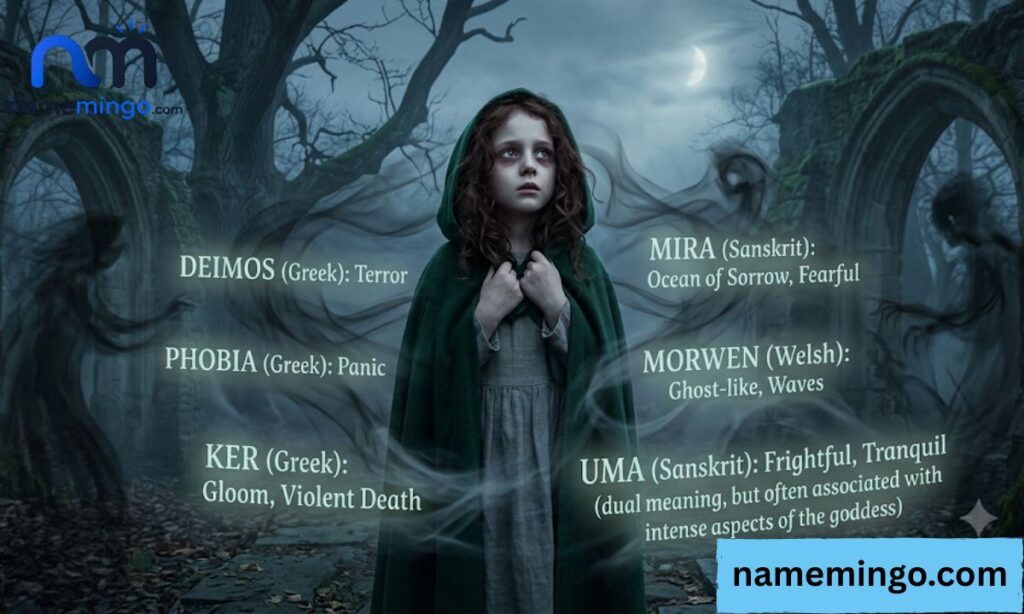
- Deima :Rooted in the Greek word for dread, this name carries a mythic, otherworldly weight. It suits a girl with a bold, unconventional presence.
- Pavora :A feminized form of the Latin pavor (terror/dread). It reads soft on the ear despite its heavy meaning.
- Trema :From the Greek tromos, meaning trembling or fear. Short, sharp, and unusual as a modern first name.
- Yirah :A Hebrew word meaning fear or awe, traditionally tied to reverence rather than terror. Increasingly used as a unisex given name.
- Khashia :Arabic in origin, meaning awe or fearful reverence. It has a lyrical, gentle sound for a heavy meaning.
- Ptoia :Derived from Greek ptoiesis, meaning terror or fright. Rare, and almost entirely unused, making it strikingly unique.
- Ceto :A Greek seagoddess name associated with monstrous dread of the deep. Dark, oceanic, and quietly powerful.
- Nyxa :Inspired by Nyx, Greek goddess of night, whose presence evoked primal fear. Feels mysterious and modern at once.
- Alala :Greek personification of the war cry, tied to battlefield terror. Bold and rhythmic as a given name.
- Moira Dread :Combines the fated “Moira” with the English word Dread, a modern hybrid style gaining niche popularity.
- Fenriska :A feminine spin on Fenrir, the terrifying wolf of Norse myth. Fierce and unconventional.
- Sable :Not etymologically “fear,” but long associated with darkness and foreboding in literary use. Popular as an atmospheric choice.
- Morrigan :A Celtic war goddess whose presence struck fear into soldiers. Increasingly chosen for its fierce, protective energy.
- Ashke Noir :A modern invented blend meaning “dark ash,” evoking dread and mystery. Popular in gothicinspired naming circles.
- Umbra :Latin for shadow, used to suggest lurking fear or the unknown. Sleek and minimalist as a name.
- Tenebris :From Latin tenebrae, meaning darkness or gloom. Dramatic and rarely used, appealing to alternative namers.
- Achlys :Greek personification of misery and deathmist. An intense, mythic choice for parents drawn to dark folklore.
- Lamia :A Greek mythological figure who devoured children out of grief and rage, historically used to frighten kids into obedience. Striking but heavy in connotation.
- Nightshade Wren :A modern naturedark hybrid name suggesting danger cloaked in beauty. Popular in gothic babynaming forums.
- Skotia :From Greek skotos, meaning darkness. A softer alternative to more literal “fear” names.
- Draga Fenn :A Slavicinspired name meaning “dear/precious,” paired with a dreadassociated surnamestyle addition for contrast.
- Ravenna Vex :Combines the raven’s ominous symbolism with “Vex,” meaning to trouble or frighten. A trending gothicmodern pairing.
- Ceridwen Ash :Welsh witchgoddess name paired with the somber tone of ash; suggests transformation through fear.
- Isolde Grim :Romantic tragedy meets dread; “Grim” nods directly to fear and foreboding.
- Freya Thorn :Norse warriorgoddess energy paired with the sharp, protective symbolism of thorns.
- Selene Noctis :”Moon” plus Latin “of the night,” evoking the fears traditionally associated with darkness.
- Vesper Wraith :”Evening” combined with a ghostly, fearevoking surnamestyle name. A dramatic modern pairing.
- Astraea Doom :Justice goddess paired with the blunt weight of “doom,” a striking contrast style.
- Ophira Night :Hebrewrooted “gold” paired with darkness, symbolizing something precious hidden in fear.
- Wren Sorrow :Nature name paired with an emotion tied closely to fear and grief.
- Elowen Grave :Cornish “elm tree” paired with a heavy, dreadlaced surnamestyle name.
- Marnie Sable :Familiar first name softened by the shadowtoned “Sable.”
- Thea Mourn :”Goddess” paired with mourning, suggesting sacred grief and fear intertwined.
- Ivy Dreadmore :A gothicliterary invented surname style, popular in fantasyinspired naming.
- Cordelia Fright :Shakespearean tragedy name paired bluntly with fear itself.
- Rhiannon Storm :Welsh mythological queen name paired with the fearassociated power of storms.
- Odessa Shade :Placename elegance paired with shadow and concealment.
- Briar Doleth :Nature name paired with an invented dreadtoned surname, popular in fantasy circles.
- Calla Wither :Flower name contrasted with decay, evoking quiet dread.
- Seraphina Night :”Fiery angel” paired with darkness, a striking lightversusfear contrast.
Names that Mean Fear of God
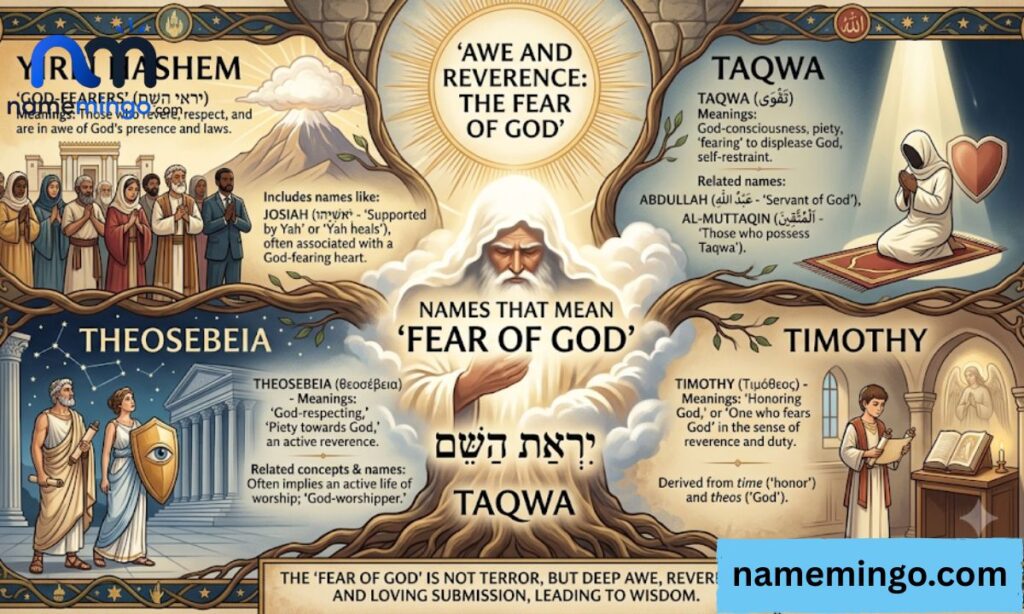
- Yirat Shamayim :A full Hebrew phrase meaning “fear of Heaven,” used as inspiration for shortened given names like Yira or Shamira.
- Taqwa :A widely used Arabic name meaning Godconsciousness or reverent fear of God, deeply rooted in Islamic tradition.
- Theophobos :Greek compound of theos (god) and phobos (fear), historically used descriptively rather than as a first name.
- Fear Wentworthstyle (Fear) :Puritan settlers in 17thcentury New England literally used “Fear” as a given name, short for “Fear of the Lord.”
- Timothea :Feminine form of Timothy, from Greek timao (honor) and theos (god); often loosely linked to reverent awe of God.
- Godfearn :An invented English compound directly translating the Puritan virtuename tradition into modern form.
- Khashyatullah :Arabicstyle compound meaning “fear/awe of Allah,” used in some Muslimmajority regions as a devotional name element.
- Yiraiah :A modern stylized variant of the Hebrew yirah, blending “fear of God” with a softer, namelike ending.
- Elohim’s Awe (Ellawe) :A modern invented shortform name symbolizing reverent fear of the divine.
- Pachadiel :A Hebrewstyle invented compound combining pachad (dread) with the divine suffix el (god).
- Reverence Hart :An English virtue name pairing directly with the concept of holy fear.
- Godly Fear (Godfry) :A modern contraction style inspired by Puritan naming conventions.
- Metatheos :Greekinspired invented name suggesting “beyond/toward god,” evoking awe.
- Deivid Khof :Combines “David” (beloved) with the Hebrew root for fear, symbolizing devotion mixed with reverence.
- Sebastia Awe :Derived loosely from sebastos (Greek, “revered”), directly paired with “Awe.”
- Fearnaught Divine :A Puritaninspired compound suggesting steadfast holy fear rather than worldly fear.
- Hazariel :Invented Hebrewstyle name blending “vision/awe” with the divine suffix.
- Theodread :A modern compound of “God” and “dread,” used in contemporary alternative naming circles.
- Awenasi :An invented name built around “awe,” designed to evoke reverence rather than terror.
- Yirmiel :A Hebrewinspired blend suggesting “God will show fear/awe,” related to the prophet name Jeremiah.
- Pavlos Theo :Combines “small/humble” (Paul) with “God,” suggesting humility born from holy fear.
- Reverentia :A Latinrooted name directly meaning reverence, historically used in ecclesiastical contexts.
- Sanctofear (Sancto) :A modern invented compound of “sacred” and “fear,” used in altnaming spaces.
- Adorai :Loosely inspired by Hebrew adon (lord), suggesting fear/respect toward a higher power.
- Elyon’s Awe (Elyawe) :Built from Elyon, a Hebrew name for God meaning “Most High,” paired with awe.
- Devotia Fear :Latinrooted “devotion” combined directly with fear, an invented devotional name.
- Kadosh Tremor :Hebrew kadosh (holy) paired with “tremor,” representing trembling before holiness.
- Numenfear :From Latin numen (divine presence/will), combined with fear.
- Theotrembla :Greek “god” combined with “tremble,” suggesting the physical response to divine awe.
- Godspeed Reverence :A modern blessingstyle compound suggesting protected, reverent fear.
A Name That Means Fear
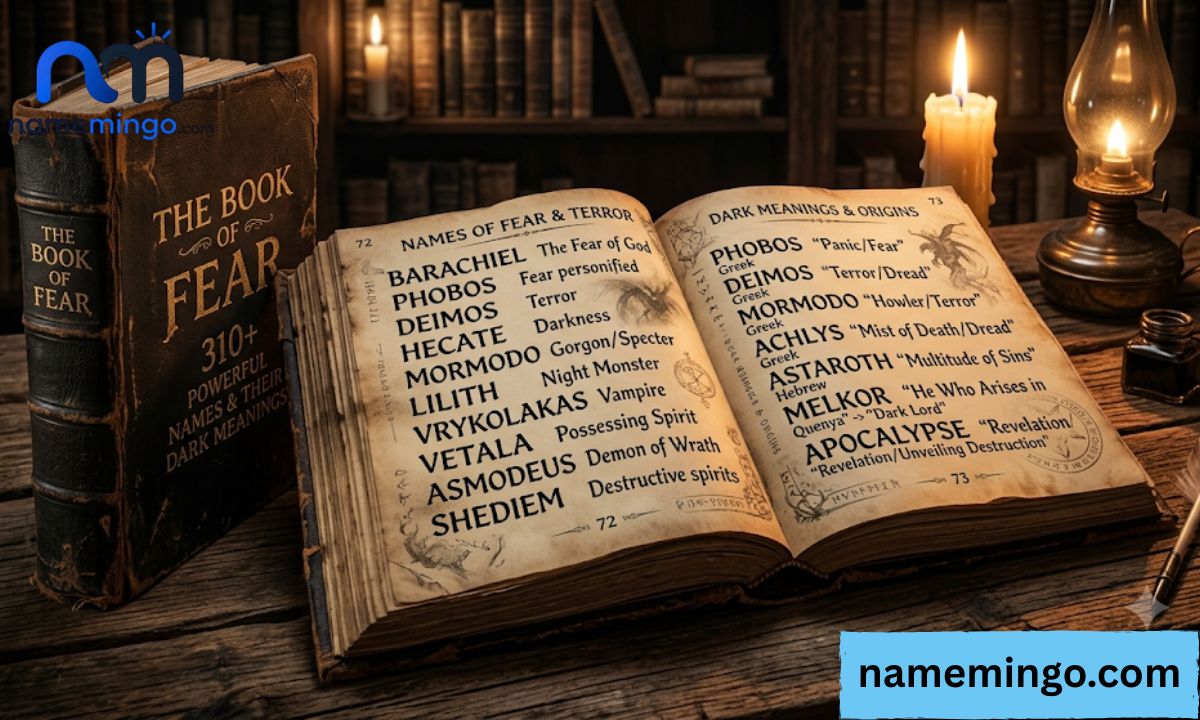
- Phobos :The Greek personification of fear itself, and namesake of one of Mars’s moons. One of the most direct “fear” names in existence.
- Timor :Latin for fear or dread, occasionally used as a rare given name in Romancelanguage regions.
- Deimos :Greek god of dread and terror, twin to Phobos, and a striking mythological choice.
- Bhaya :Sanskrit for fear, used in South Asian naming traditions with symbolic or cautionary intent.
- Khawf :Arabic for fear, occasionally used as an evocative or literary given name.
- Bhīti :Another Sanskrit term for fear or dread, softer in sound than Bhaya.
- Bibhatsa :Sanskrit for dread or disgust, used in classical literature and rare naming contexts.
- Fright :A direct English virtue/emotion name, almost never used but occasionally appearing in modern altnaming trends.
- Angst :German for fear or anxiety, adopted informally into English and occasionally used stylistically.
- Metus :Latin for fear or apprehension, historically personified as a minor Roman deity.
- Formido :Latin for terror or dread, from which the English word “formidable” derives.
- Pavor Nocturnus :Latin medical term literally meaning “night terror,” occasionally shortened to “Pavor” as a name.
- Tromos :Greek for trembling or fear, root of the English word “tremor.”
- Trepidus :Latin for anxious or fearful, root of the English word “trepidation.”
- Anxietas :Latin origin of “anxiety,” occasionally used stylistically as a dramatic given name.
- Woga :Swahili for fear, used in East African naming traditions with symbolic meaning.
- Hofu :Another Swahili word for fear, sometimes chosen to reflect a difficult birth story.
- Eagla :Irish Gaelic for fear, rarely used but linguistically authentic.
- Ótti :Icelandic for fear, striking and minimalist in modern naming circles.
- Furcht :German for fear, blunt and rarely adopted as a first name.
- Peur :French for fear, occasionally stylized into softer name forms like “Peuria.”
- Miedo :Spanish for fear, sometimes stylized as “Miedra” in creative naming.
- Medo :Portuguese for fear, phonetically soft despite its heavy meaning.
- Kyofu :Japanese for fear, rarely used as a given name but recognizable in pop culture.
- Gonggu :Korean for fear, occasionally referenced in literary or artistic naming.
- Fenrix :An invented modern name evoking Fenrir, the fearinspiring wolf of Norse legend.
- Terrence Dread :A modern pairing of the familiar name Terrence with the blunt word “Dread.”
- Cower :An English word rarely but occasionally adopted stylistically in alternative naming circles.
- Quiver :Suggests the physical trembling associated with fear; used decoratively rather than literally.
- Skittish :An English descriptive term occasionally borrowed into nickname culture.
- Trembla :A softened, namelike adaptation of “tremble.”
- Doomsworth :A modern invented compound suggesting a name “worthy of dread.”
- Grimhold :A fantasyinspired compound suggesting one who holds or embodies fear.
- Nyctophobe :Directly built from “nyctophobia” (fear of the dark), used in altnaming circles.
- Fearghas :An authentic Gaelic name meaning “man of fear/choice,” historically anglicized to Fergus.
- Fearghal :Related Gaelic name meaning “man of valor,” often mistranslated informally as “fear” due to its spelling.
- Ferris (Fearinspired) :A modern soft phonetic echo of “fear,” though its true root is unrelated.
- Dredmund :An invented Old English–style compound suggesting “protector against dread.”
- Anxu :A stylized modern shortform inspired by “anxiety.”
- Trepid :A shortened stylistic adaptation of “trepidation,” used in minimalist modern naming.
Also Read This:186+ Celestial Names: Beautiful Names Meaning Sky
A Name That Means No Fear
- Abhaya :Sanskrit for “fearless,” widely used across South Asia and associated with a wellknown protective hand gesture in Buddhist and Hindu iconography.
- Nirbhaya :A stronger Sanskrit intensifier meaning “utterly fearless,” gained wider recognition as a symbolic name in India.
- Eadric :Old English name meaning “wealthy and brave,” often associated with fearlessness in battle.
- Baldric :Germanicrooted name meaning “bold ruler,” carrying connotations of courage over fear.
- Ard :Irish for “high” but frequently paired in compound names suggesting boldness and fearlessness.
- Conall :Irish name meaning “strong wolf,” historically tied to fearless warriors.
- Eberhard :German compound meaning “brave as a boar,” a direct symbol of fearlessness.
- Kenji :Japanese name that can mean “strong and vigorous,” often chosen for its association with fearless resolve.
- Idris :Welsh/Arabic name associated with ardent leadership and fearlessness in various traditions.
- Zale :Greekinspired modern name meaning “strength of the sea,” used to suggest calm fearlessness.
- Valor :A direct English virtue name meaning courage in the face of fear.
- Audhild :Old Norse name combining “wealth” and “battle,” symbolizing fearless resolve.
- Bold :Rare but used as a literal English virtue name in some modern altnaming circles.
- Halvard :Norse name meaning “rock defender,” used to suggest steady fearlessness.
- Þórvald (Torvald) :Old Norse compound invoking Thor and “ruler,” symbolizing fearless strength.
- Björn :Scandinavian for “bear,” a classic symbol of fearless power.
- Nirbhay Kaur/Singh :A directly used Sikh name meaning “fearless,” common in Punjabi naming traditions.
- Sherzod :Central Asian (Uzbek/Tajik) name meaning “lionborn,” symbolizing fearlessness.
- Aslan :Turkic word for “lion,” widely used to symbolize courage and fearlessness.
- Leo/Leona :Latin for “lion,” among the most common fearlessnessassociated names worldwide.
- Zubair :Arabic name meaning “strong, firm,” associated with fearless character.
- Haidar :Arabic name meaning “lion,” directly symbolizing bravery over fear.
- Ansgar :Old Germanic name meaning “spear of God,” suggesting fearless divine protection.
- Ealdian (Elden) :Old English root suggesting steadfastness and fearless endurance.
- Constanza :Latinrooted name meaning “steadfastness,” used to suggest calm in the face of fear.
What’s the Name That Means Fear of Your Past
This is a poetic rather than strictly linguistic category :few languages have a single word for “fear of one’s past,” so names here are symbolic pairings or invented compounds designed to capture that specific emotional weight.
- Retromor :An invented Latinstyle blend of retro (backward) and timor (fear), symbolizing dread of what came before.
- Mnemophobe :Built from Greek mnēmē (memory) and phobos (fear), directly evoking fear of memory itself.
- Paleofear :A modern compound using Greek palaios (ancient/old) paired with fear, suggesting dread of the past.
- Umbraheri :An invented blend of “shadow” (umbra) and “yesterday” (Latin heri), symbolizing a haunted past.
- Reveniscia :Loosely built from Latin revenire (to come back), suggesting fear of memories returning.
- Echofright :A modern English compound suggesting fear triggered by echoes of past events.
- Ghostwren :A symbolic natureandhaunting pairing suggesting a past that lingers like a spirit.
- Hauntley :An invented surnamestyle name directly evoking being haunted by history.
- Regretta :A stylized feminine form built from “regret,” used symbolically for pastrelated fear.
- Wraithmere :A fantasyinspired compound suggesting a lake or pool of past ghosts and fears.
- Palimpsest Rae :Borrowing the literary term for a manuscript with visible traces of its past, paired with a soft first name.
- Yesterfear :A direct modern compound of “yester” (as in yesteryear) and “fear.”
- Yireshade :Blends the Hebrew yirah (fear/awe) with “shade,” suggesting a fear that follows like a shadow.
- Yesterval :An invented compound suggesting a “valley of yesterday,” symbolic of a haunted personal history.
- Memrys Vale :A stylized “memories valley” name, symbolic of unresolved past fear.
Top 5 Trending Picks in 2026
- Yirah :This Hebrewrooted name is gaining traction as a unisex choice, favored for its dual meaning of fear and reverent awe. Parents are drawn to its spiritual depth and short, modern sound.
- Aslan :Long popular in literary circles, this Turkic “lion” name is trending for its fearless symbolism and easy crossover appeal across cultures. Its strong, singlesyllablefriendly sound fits current naming trends.
- Nyxa :Inspired by the Greek goddess of night, this invented feminine form is rising fast in gothicmodern naming communities. It pairs mythological weight with a soft, contemporary ending.
- Taqwa :Widely used in Muslimmajority communities and increasingly recognized elsewhere, this name’s meaning of reverent Godconsciousness resonates with families seeking spiritually grounded names. It’s both traditional and quietly trending in diaspora communities.
- Nirbhaya :Following its symbolic use in India as a name representing fearlessness and resilience, this Sanskrit name continues to see renewed interest among parents wanting to name a daughter after strength rather than fear itself.
Why FearBased Names Are Rising in Modern Identity
Fearthemed names sit at an interesting cultural crossroads in 2026. On one hand, there’s a renewed interest in reclaiming difficult emotions rather than avoiding them :parents are drawn to names like Nirbhaya or Abhaya specifically because they transform fear into a statement of resilience. On the other, gothic and mythological aesthetics have surged in mainstream pop culture, pulling names like Nyxa, Deimos, and Phobos out of ancient texts and into modern naming shortlists.
There’s also a spiritual thread running through this trend. Names meaning “fear of God” :Taqwa, Yirah, and their many variants :reflect an older tradition where fear wasn’t something to escape but something sacred, tied to humility and reverence rather than terror. As more parents look past conventional “pretty sounding” names toward names with layered meaning, fearrooted names offer something rare: emotional honesty, mythic weight, and a sense that a name can hold complexity rather than simplicity.
Subtle Names That Carry Fear Through Meaning
Delma :Rooted in old Germanic sound patterns tied to “shield,” it carries a quiet undertone of guardedness. Parents drawn to softsounding names with a protective, wary edge often find this one fitting.
Anwen :A Welsh name usually read as “fair” or “beautiful,” but its softer syllables have historically been linked to shy, timid temperaments. It reads gentle on the surface while hinting at inward caution.
Ilta :A Finnish name meaning “evening,” evoking the uneasy hush that falls as light fades. It’s often chosen for its whispery, dusklike quality that suggests quiet apprehension.
Ombra :Derived from the Italian word for “shadow,” this name doesn’t announce fear outright but lets it linger in the background. It suits a child whose name should feel mysterious rather than menacing.
Sable :English in usage, tied to the color black and the sable animal, it carries connotations of darkness and mourning. The word has long been associated with funeral drapery, giving it a hushed, somber weight.
Verity :Meaning “truth,” it seems an unlikely fearname until you consider how often truth is something people dread facing. It carries an ironic tension between honesty and the anxiety truth can provoke.
Elowen :A Cornish name meaning “elm tree,” elms being trees historically planted near graveyards. The botanical link quietly ties the name to mourning and unease.
Ashra :With roots suggestive of “ash,” it evokes what’s left after fire and destruction. The imagery is calm on its face but carries the memory of something frightening having passed through.
Nyra :A modern invented name with phonetic echoes of “night” and “ire,” blending darkness and quiet anger. It feels contemporary while still carrying an unsettled undertone.
Wren :Traditionally just a small bird’s name, but in folklore wrens were seen as omens, watched warily by those who believed in superstition. The subtlety lies in its ordinary sound masking older superstitious fears.
Marlow :An English surnameturnedfirstname meaning “remnants of a lake,” evoking still, dark water people have long been wary of. Its literary use in “Heart of Darkness” adds a layer of dread beneath the surface.
Isolde :From Arthurian legend, meaning uncertain but often tied to “ice ruler,” suggesting coldness and emotional distance. The tragic nature of her legend gives the name a somber, apprehensive shadow.
Fenn :Short for “fen,” referring to marshland long associated with fog, disorientation, and folklore about things lurking within. Its brevity makes the fear feel understated rather than obvious.
Corvina :Derived from “corvus,” the Latin word for raven, a bird tied to omens and death in Western superstition. The elegance of the name hides its unsettling bird symbolism.
Thessaly :Referencing an ancient Greek region famous in myth for witchcraft and dark magic. It carries an air of the uncanny without ever naming fear directly.
Lior :A Hebrew name meaning “my light,” chosen here for contrast :light is comforting, but the vigilance of needing light at all hints at fear of the dark it dispels.
Names That Mean Anxiety Girl

Perpetua :A Latinrooted name meaning “perpetual” or “continuous,” which some parents interpret as symbolic of ongoing worry or restlessness. Its historical use for an early Christian martyr adds a layer of endurance through distress.
Tremora :An invented, modern name built from “tremor,” directly suggesting the shaking associated with nervousness. It’s chosen by parents who want an unmistakable link to anxious energy.
Ansley :Though commonly read as an English surname meaning “hermit’s meadow,” its phonetic closeness to “anxious” has made it popular among parents seeking a subtle nod to nervous energy. The sound alone carries tension.
Ridwana :An Arabicinfluenced name sometimes associated with inner unrest before finding contentment, symbolizing the anxious road to peace. It suggests struggle preceding calm.
Careen :Related to the nautical term meaning to tip or lurch unsteadily, evoking the sensation of losing balance under stress. It captures the physical feeling anxiety can produce.
Fretta :Derived loosely from “fret,” directly tied to worry and unease. Its Italiansounding lilt softens what is otherwise a very literal anxious reference.
Restina :A constructed name playing on “restless,” suggesting a girl whose energy is anxious rather than calm. It has a lyrical quality despite its uneasy root meaning.
Uneasa :An invented name built directly from “unease,” used by parents wanting an unmistakable connection to nervous tension. It reads as unusual but carries clear symbolic weight.
Solenne :A Frenchinspired name often meaning “solemn,” reflecting the heavy, serious mood anxiety can bring. Its elegance masks the underlying weight of worry.
Ferrah :A variant soundalike of “fear” wrapped into a softer, more femininesounding name. It plays with phonetics to hint at unease without spelling it outright.
Nervina :Constructed from “nerve,” this name leans directly into the physical sensation of anxious energy. It’s rare, but its intent is unmistakable to those who know its root.
Worrenna :A modern blended name derived from “worry,” made to sound more traditional through added syllables. It’s chosen specifically for its transparent symbolic tie to anxious feelings.
Skittish used as inspiration for Skye Ashling :a compound name combining lightness (“Skye”) with an old English root (“Ashling,” meaning “vision” or “dream”) often tied to restless dreaming. Together they suggest a mind that doesn’t easily settle.
Panika :Derived from “panic,” softened with a feminine ending to make it usable as a first name. It’s a bold, direct choice for parents wanting to acknowledge anxious energy openly.
Disquieta :A Latininflected invented name built from “disquiet,” meaning unsettled or uneasy. It’s chosen for its poetic, almost gothic sound despite its heavy meaning.
Also Read This:260+ Beautiful Names That Mean Blue (with Meanings & Origins)
Names That Mean Fear Girl
Phobia rendered softly as Phobe :A shortened, namelike adaptation of the Greek root for fear, “phobos.” It’s an unconventional but direct choice for parents wanting fear built into the very sound of the name.
Deimara :Inspired by Deimos, the Greek god personifying dread and terror, softened with a feminine suffix. It carries mythological weight tied directly to fear itself.
Timora :Derived from the Latin “timor,” meaning fear, given a lyrical feminine ending. It’s a scholarly choice for parents who want the meaning to be etymologically precise.
Awenna :Built from “awe,” a word historically tied as much to fear and reverence as to wonder. The name balances beauty with an undertone of trembling respect.
Direna :Formed from the English word “dire,” meaning fearfully serious or urgent. It suggests seriousness bordering on dread.
Grimhilde :A Germanic name meaning roughly “battle mask” or “fierce battle,” historically tied to warrior figures meant to inspire fear in enemies. It carries a fierce, intimidating undertone.
Formidel :Adapted from “formidable,” meaning inspiring fear or respect through strength. It suggests a girl whose presence itself commands cautious attention.
Terrowyn :A blended name combining “terror” with the Welshstyle suffix “wyn,” meaning fair or white. It softens a harsh root into something more musical.
Paventa :From the Italian “paventare,” meaning to fear or dread. It carries a Mediterranean lyrical quality while staying rooted in literal fear.
Angsta :A softened, feminized version of “angst,” the Germanrooted word for a deep, existential fear or dread. It’s chosen for parents wanting a modern, almost punkinspired edge.
Fearne :A homophonic play on “fear” merged with the traditional name “Fern,” creating something that reads naturally while nodding to its darker root. It’s subtle enough for daily use.
Dredra :Constructed from “dread,” with a softened ending to make it usable as a first name. It’s stark and direct in its symbolism.
Horrenza :Adapted from “horror,” given an Italianate flourish to soften its harshness. It’s an unusual but bold choice tied unmistakably to fear.
Craven :Traditionally a surname meaning “cowardly” or fearful, occasionally repurposed as a strikingly direct first name. Its bluntness makes it memorable, if unconventional.
Nightmara :A modern invented name blending “nightmare” with a feminine ending, evoking fear experienced in sleep. It leans gothic and dramatic by design.
Girl Names That Mean Fear and Power
Bellona :The Roman goddess of war, her name meaning “to fight,” combining fearsome battle imagery with commanding strength. She was feared precisely because of her power on the battlefield.
Kali :A major Hindu goddess whose name is linked to time and dark power, worshipped as a fierce, fearsome protector against evil. Her ferocity is inseparable from her role as a powerful guardian deity.
Morrigan :An Irish war goddess associated with fate, death, and battle, whose presence was said to strike fear into warriors. Her name carries both dread and reverence in equal measure.
Enyo :A Greek goddess of war often depicted alongside Ares, her name tied to destruction and the terror of conflict. She represents fear used as a tool of dominance.
Valkira :A stylized variant of “Valkyrie,” the Norse female figures who chose the fates of warriors in battle. Their presence was both feared and revered as arbiters of life and death.
Scathach :A legendary Scottish warrior woman whose name means “the shadowy one,” tied to her fearsome reputation as a trainer of heroes. She embodies fear used in service of formidable skill.
Furiana :Derived from “fury,” referencing the Roman Furies, spirits of vengeance who inspired terror in wrongdoers. Their power lay precisely in the fear they provoked.
Draven :A modern name evoking “dread” and “raven,” combining ominous bird symbolism with an assertive, powerful sound. It’s popular for its dark, commanding tone.
Ragnhild :A Norse name meaning “battle counsel” or “she who advises in war,” tied to strength born from strategic fearlessness. It carries a legacy of formidable female leadership.
Sekhmet :An Egyptian lioness goddess of war and healing, whose ferocity was said to be capable of great destruction if unchecked. She represents raw power that inspired both fear and protection.
Andraste :A Celtic goddess of victory invoked before battle, her name tied to invincibility achieved through fearsome resolve. Warriors called upon her precisely because of the dread she could bring to enemies.
Hecate :A Greek goddess of magic and the crossroads, long associated with night, shadows, and the unknown. Her power was considered immense precisely because it was feared and not fully understood.
Nemesis :The Greek goddess of retribution, whose very name has become synonymous with a feared and inevitable reckoning. She embodies power through the fear of consequence.
Brynhild :A Norse shieldmaiden whose name means “armor battle,” representing fierce strength wrapped in protective resolve. Her legend intertwines fear, love, and formidable will.
Ashira Storm :A modern compound name pairing “Ashira,” meaning “I will sing,” with “Storm,” evoking natural power capable of inspiring awe and fear alike. Together they suggest a voice powerful enough to command a room.
Bold Names That Directly Represent Fear
Terror :Used rarely and boldly as a given name, taken directly from the English word for extreme fear. It’s an unmistakable, unfiltered choice with no room for subtlety.
Dread :A stark English wordname referencing anticipatory fear or apprehension. Its directness makes it a striking, unconventional pick.
Phobos :The Greek god personifying fear itself, son of Ares, used as a bold, mythologically rooted first name. It carries the full etymological weight of “phobia.”
Doom :An Old English word meaning judgment or fate, evolved in modern usage to suggest impending disaster and fear. Its blunt sound leaves nothing to interpretation.
Grim :Derived from Old English, meaning fierce or severe, later associated with death and foreboding through folklore. It’s a short, weighty name that carries fear plainly.
Scarlett Fear used stylistically as Scarr :A shortened, invented form playing on “scar” and implied fright, chosen for its blunt, edgy sound. It suggests toughness born from something frightening survived.
Malice :An English wordname meaning intent to cause harm, carrying an unmistakable menace. It’s bold precisely because of how openly unsettling it sounds.
Vex :Derived from the verb “to vex,” meaning to trouble or distress, often used to suggest a mischievous, unsettling presence. Its short, sharp sound matches its unsettled meaning.
Banshee :Taken from Irish folklore, referring to a spirit whose wail was believed to foretell death. Used as a name, it directly channels the fear associated with the legend.
Wraith :A Scottishorigin word referring to a ghost or apparition, historically an omen of death. As a name, it’s unapologetically tied to spectral fear.
Grislea :Adapted from “grisly,” meaning causing horror or fear, softened with a feminine ending. It keeps the bluntness of the root word while sounding usable as a name.
Fright :Used directly and rarely as a first name, taken from the plain English word for sudden fear. Its rarity makes it a deliberately shocking choice.
Menace :An English wordname meaning a threat or danger, chosen for its unfiltered, confrontational tone. It leaves no ambiguity about its intended effect.
Vhastra :A stylized invented name built to sound harsh and imposing, designed to evoke a sense of vague, unspecified dread. It’s chosen purely for its unsettling phonetic quality.
Ravenna Fear shortened to Ravenna :While traditionally an Italian place name, its raven root ties it to omens of death, and paired conceptually with “fear,” it becomes a bold, symbolic choice. It reads elegant while carrying dark undertones.
Gothic and Literary Names with Fearful Undertones
Lenore :Immortalized by Edgar Allan Poe’s “The Raven,” where the narrator mourns her loss amid dread and haunting grief. The name has since carried a permanent association with gothic sorrow and fear.
Ligeia :The title character of another Poe story, a woman whose death and uncanny return blur the line between love and horror. Her name evokes obsession shadowed by dread.
Miriam Blackwood :Echoing Shirley Jackson’s gothic sensibilities, particularly “We Have Always Lived in the Castle,” where isolation and suspicion create constant unease. The surname alone conjures shadowed woods and secrets.
Mina :The heroine of Bram Stoker’s “Dracula,” caught in a story built entirely around fear of the unknown and the undead. Her name carries the tension between vulnerability and resilience against terror.
Justine :A character from Mary Shelley’s “Frankenstein,” whose wrongful fate underscores the novel’s themes of dread, guilt, and monstrous consequence. The name carries tragic, fearful literary weight.
Cathy :Emily Brontë’s Catherine Earnshaw from “Wuthering Heights,” whose ghost is said to haunt the moors, tying her name to eerie, restless longing. The novel’s gothic atmosphere colors the name permanently.
Carmilla :The titular vampire of Sheridan Le Fanu’s novella, predating and influencing Dracula, wrapped in seduction and dread. Her name is now shorthand for gothic horror itself.
Ophelia :Shakespeare’s tragic figure from “Hamlet,” whose descent into madness and death is steeped in melancholy dread. The name carries centuries of association with fragile fear and tragedy.
Isadora Grimm :Evoking the Brothers Grimm, whose fairy tales are laced with real menace beneath their whimsy. The surname alone signals danger dressed in storybook clothing.
Annabel :Drawn from Poe’s poem “Annabel Lee,” a love story shadowed by death and loss in a “kingdom by the sea.” The haunting rhythm of the poem lends the name a melancholic, eerie undertone.
Roderick :The doomed protagonist of Poe’s “The Fall of the House of Usher,” whose fear and decay mirror his crumbling ancestral home. The name is inseparable from dread and psychological collapse.
Wednesday :Popularized by “The Addams Family,” a character whose deadpan darkness has become a modern icon of gothic charm layered with quiet menace. The name itself, once ordinary, now carries instant eerie recognition.
Hesper :Meaning “evening star,” used in gothic literature to evoke the fading of light and the approach of night’s uncertainty. It’s a quieter literary nod to encroaching darkness.
Victoria Frankenstein :Referencing Mary Shelley’s novel indirectly, invoking themes of creation gone wrong and the fear of consequences beyond control. The surname alone carries instant gothic recognition.
Emily Dane :Echoing Emily Brontë and the eerie moorland settings of gothic fiction, paired with “Dane,” suggesting old, weathered lineage. Together the name feels steeped in inherited unease.
Lilith :Drawn from folklore predating biblical texts, often portrayed as a figure of dark independence and feared power. Her name has long been used in literature to evoke defiance shadowed by dread.
Names That Mean Fear in Japanese
Kyouko (恐子) :Built from the kanji “kyou” (恐), meaning fear or dread, combined with “ko” (子), meaning child. It directly and openly names the emotion within its structure.
Osore (畏れ) :A wordname derived from the Japanese term for fear or awe, often used in a reverent, almost spiritual sense. It suggests fear mixed with deep respect.
Fuan (不安) :Meaning “anxiety” or “unease,” this termbased name is built from characters meaning “not” and “peaceful.” It directly conveys a lack of calm.
Kowagaru (怖がる)inspired name Kowa :Shortened from the verb meaning “to be afraid,” used stylistically as a given name. It keeps the root feeling of fright intact in abbreviated form.
Senritsu (戦慄) :Meaning “shudder” or “tremble with fear,” this term captures a physical reaction to dread. Used as a name, it conveys visceral, immediate fear.
Kyoufu (恐怖) :A direct compound meaning “terror” or “horror,” combining characters for fear and dread together. It’s one of the most literal Japanese fearrelated name choices.
Odoroki (驚き) :Meaning “surprise” or “shock,” which in Japanese often carries an element of fearful startlement rather than pleasant surprise. It suggests a sudden jolt of dread.
Ayashii (怪しい)inspired name Ayashi :Derived from the word meaning “suspicious” or “eerie,” often used to describe unsettling, supernatural phenomena. It carries a ghostly, uncanny connotation.
Bimyou (微妙) blended with fear tones as Bimyoukyou :A constructed name suggesting a “subtle dread,” combining the idea of subtlety with fear’s root character. It’s an invented but thematically consistent choice.
Youkaiinspired name Youka (妖花) :While “youkai” refers to supernatural spirits often tied to fear in Japanese folklore, “youka” softens it into “bewitching flower,” retaining a haunting undertone. It nods to the eerie without using the word directly.
Shizuka no Osore shortened to Shizosore :A constructed blend of “shizuka” (quiet) and “osore” (fear), suggesting a quiet, internalized dread. It’s an invented compound meant to feel poetic rather than literal.
Kage (影) :Meaning “shadow,” a word deeply tied in Japanese storytelling to hidden fears and the unknown lurking just out of sight. It’s simple, elegant, and quietly ominous.
Yamiko (闇子) :Combining “yami” (闇), meaning darkness, with “ko” (子), meaning child. The name directly ties its bearer to imagery of darkness and the fear it can represent.
Rei (霊) :Meaning “spirit” or “ghost” depending on the kanji used, tied closely to Japan’s rich tradition of ghost stories and supernatural dread. It’s short, elegant, and quietly eerie.
Obakeinspired name Obaka :softened from “obake” (お化け), the Japanese term for shapeshifting ghosts and monsters central to folklore. It nods playfully but clearly to supernatural fear.
NatureInspired Names That Evoke Fear
Tempest :Directly referencing violent storms, this name evokes the primal fear humans have long held toward uncontrollable weather. Its dramatic sound matches its turbulent meaning.
Cypress :A tree historically planted in graveyards across Mediterranean cultures, tying its otherwise peaceful sound to mourning and death. The association gives it a quietly somber undertone.
Nyxis :Inspired by “Nyx,” the Greek personification of night, and adapted to evoke the natural fear of darkness. It carries the vast, unknown quality of a moonless sky.
Thornwyn :Combining “thorn,” suggesting danger and pain hidden within beauty, with the softening suffix “wyn.” It reflects nature’s ability to be both alluring and hazardous.
Marisol Noir :Blending “Marisol” (sea and sun) with “noir” (black), creating tension between light and darkness within a single name. It suggests beauty shadowed by something ominous.
Wraithwood :A constructed name combining “wraith” with “wood,” evoking dense, shadowed forests long associated with folklore about lurking spirits. It leans heavily into the eerie side of nature.
Stormy :A straightforward naturebased name referencing turbulent weather, chosen for its direct link to unpredictability and the unease storms provoke. It’s simple but effectively evocative.
Fenwick :Meaning “marsh farm,” tying the name to fens and bogs long associated in folklore with disorientation and danger. The murky terrain gives it a quietly unsettling edge.
Ravensmoor :Combining “raven,” a bird tied to omens, with “moor,” referencing the wild, fogladen landscapes of gothic literature. Together they conjure isolation and watchful dread.
Wolfsbane :Named after the poisonous plant historically associated with werewolf folklore and used to ward off supernatural threats. It carries both danger and protective mysticism.
Duskra :An invented name built from “dusk,” the transitional time associated with fading safety and rising unease. It captures the moment fear begins to creep in with the light.
Briar :Referencing thorny, tangled plants long used in fairy tales to symbolize danger and obstacles guarding something precious. Its softness contrasts with the pain thorns imply.
Mossgrave :Combining “moss,” suggesting old, undisturbed places, with “grave,” directly invoking death and burial. It’s a heavier nature name leaning fully into somber imagery.
Willowdusk :Merging the traditionally gentle “willow” tree with “dusk,” creating a name that balances softness with encroaching darkness. It suggests beauty tinged with quiet foreboding.
Frostbane :Combining “frost,” representing cold and stillness, with “bane,” meaning something that causes harm or ruin. Together it evokes nature’s colder, more dangerous side.
Cultural Perspectives on FearBased Names
Bhaya :A Sanskritrooted term meaning “fear,” occasionally used in South Asian contexts within compound names or spiritual discussions of overcoming dread. It reflects a philosophical rather than purely literal approach to naming fear.
Khawf (خوف) :An Arabic term meaning “fear,” often discussed in Islamic spiritual texts as a reverent fear of the divine rather than worldly dread. It carries theological weight distinct from Western fearnaming traditions.
Phobosderived names in Greek culture :Ancient Greeks personified fear as the god Phobos, whose name became the root for the modern word “phobia” across many languages. This mythological approach treated fear as a divine force rather than simply an emotion.
Angst in Germanspeaking cultures :The word “angst” carries deep philosophical weight in German thought, particularly through existentialist writers who treated it as a fundamental human condition rather than a fleeting emotion. Its use as a nameadjacent term reflects that heavier cultural framing.
Miedo in Hispanic naming traditions :While “miedo” (fear) itself isn’t used directly as a first name, Spanishlanguage literature and folklore often personify fear through figures like “El Cuco,” influencing indirect naming choices tied to caution and respect for the unknown. Cultural storytelling shapes how fear is symbolically honored.
Ubuntuadjacent fear concepts in African naming traditions :In many African cultures, names referencing caution or respect for unseen forces are chosen deliberately to invoke protection rather than literal dread. The naming reflects communal wisdom about navigating danger safely.
Yūreiinfluenced naming in Japan :Japanese ghost lore, or “yūrei,” has historically influenced indirect naming choices tied to spirits and the unknown, particularly in artistic and literary contexts. Names touching on this tradition carry deep cultural resonance around respecting the dead.
Native American cautionbased names :Various Indigenous naming traditions include names meant to instill respectful caution toward nature’s power rather than direct fear, reflecting a relationship of reverence rather than dread. These names often emerge from storytelling passed through generations.
Celtic Samhaininfluenced names :The Celtic festival of Samhain, precursor to Halloween, centered on the belief that spirits crossed into the living world, influencing naming traditions tied to protection during that liminal time. Names from this tradition often carry dual meanings of caution and celebration.
Slavic domovoiinspired naming :Slavic folklore features household spirits like the domovoi, whose presence required respectful acknowledgment to avoid misfortune, shaping indirect naming customs around caution and unseen forces. This reflects a cultural blending of fear and household protection.
Norse “Ragnarök” influenced names :Referencing the Norse apocalyptic myth, some naming traditions draw on themes of inevitable doom and courage in the face of fear. Names touching this mythology often symbolize bravery forged through dread.
Chinese hungry ghost festival influence :Cultural observances like the Hungry Ghost Festival shape naming caution around timing and symbolism tied to spirits and respect for ancestors. Indirect naming choices during this period often reflect protective intent.
Persian “Dev” mythology influence :Persian folklore features “divs,” demonic figures embodying fear and chaos, historically influencing storytelling more than direct naming. Their legacy still colors how fear is symbolically represented in Persianinfluenced literature.
Filipino aswanginfluenced caution naming :Philippine folklore’s aswang myths have shaped community storytelling traditions where names carry protective, cautionary undertones rather than literal fear. The cultural framing emphasizes vigilance and communal safety.
Egyptian Apepinfluenced symbolism :Ancient Egyptian mythology personified chaos and fear through the serpent god Apep, an enemy of order and light. This mythological duality has influenced symbolic naming choices centered on light triumphing over dread.
Irish banshee cultural naming caution :Irish folklore’s banshee tradition has historically shaped naming caution around foretelling death, influencing indirect symbolic references rather than direct usage. It remains one of the most culturally recognizable fearlinked folklore traditions globally.
Curated Names That Mean Fear (With Meanings)
Deimos :Greek in origin, meaning “dread” or “terror,” this was the name of the god personifying fear in ancient mythology. It remains one of the most direct etymological links to fear available.
Phobos :The Greek word directly translating to “fear,” later the root of the modern term “phobia” used across many languages. It’s the clearest linguistic ancestor of fearbased naming.
Timor :A Latin word meaning “fear” or “dread,” historically used in philosophical and religious texts discussing the nature of dread. Its formal, scholarly tone makes it a distinguished choice.
Pavor :Another Latin term for fear, specifically referencing sudden panic or terror rather than lingering dread. It carries an immediate, visceral quality within its short form.
Angst :A Germanderived word meaning deep anxiety or dread, adopted into English particularly through existentialist philosophy. It carries intellectual weight alongside its emotional meaning.
Formido :Latin for “dread” or “terror,” historically used in classical texts to describe overwhelming fear in the face of danger. Its rarity as a name choice makes it distinctive.
Trepidus :Latin, meaning “trembling with fear” or “alarmed,” the root of the modern English word “trepidation.” It conveys physical restlessness alongside emotional unease.
Horror :Directly from Latin, originally meaning “to bristle” or “shudder,” evolving into the modern word for intense fear or dread. Its stark, unfiltered meaning makes it a bold naming choice.
Terror :Also Latinrooted, meaning “great fear,” historically used to describe overwhelming dread inspired by danger or threat. It remains among the most recognizable fearrelated words globally.
Dread :An Old English word describing intense fear of something that has not yet happened, tied closely to anticipation and foreboding. Its native English roots give it a plain, weighty directness.
Alarm :Derived from the Italian phrase “all’arme” (“to arms”), historically tied to the fear and urgency of impending attack. Over time it softened into general warning, but its root remains steeped in dread.
Panic :From the Greek god Pan, whose sudden appearance was believed to cause irrational, overwhelming fear in those who encountered him. The word retains that mythological association with sudden, uncontrollable dread.
Fright :An Old English term for sudden, intense fear, closely related to “afraid.” Its short, sharp sound mirrors the abruptness of the emotion itself.
Qualm :Originally referring to a sudden feeling of faintness or unease, later evolving to mean a pang of doubt or anxious hesitation. It suggests a quieter, more internal form of fear.
Trepidation :Derived from the same Latin root as “trepidus,” meaning a state of fear or anxiety about something uncertain. It’s a more formal, literary way of naming apprehensive dread.
Consternation :From Latin, meaning a feeling of anxious dismay or confusion, often in response to something unexpected. It suggests fear tangled together with shock.
Dismay :Rooted in Old French and Latin, meaning a sudden loss of courage or confidence in the face of trouble. It captures the moment fear undermines resolve.
Frequently Asked Questions
What name means fear?
Names like Dread, Grim, and Roran mean fear or dread in different cultures.
What is a powerful dark name?
Mordred, Raven, and Damien are popular names with dark, powerful meanings.
What names mean scary or evil?
Names like Diablo, Lucian, and Malik carry scary or evil meanings.
Is there a name that means “fearless”?
Yes, names like Ivar, Aric, and Griffin mean brave or fearless.
What girl names mean fear or darkness?
Nyx, Morrigan, and Lilith are girl names linked to fear and darkness.
What boy names mean fear or terror?
Boy names like Grimm, Ares, and Sabbath are linked to fear or terror.
Conclusion
Fear has always shaped how people name things. Across cultures, parents and storytellers chose names that carried weight and warning. These names remind us that darkness has always had a voice.
Choosing a name tied to fear is not a bad thing. It can show strength, mystery, or respect for old traditions. In the end, these names prove that fear can be powerful too.

Daniel is the creator of Namemingo.com, a writer guided by curiosity and a deep passion for the stories behind names. With a background in linguistics, cultural history, and name etymology, Daniel transforms complex research into clear, engaging, and easy-to-understand content. His writing invites readers to explore the rich origins, spiritual meanings, and cultural significance hidden within everyday names.