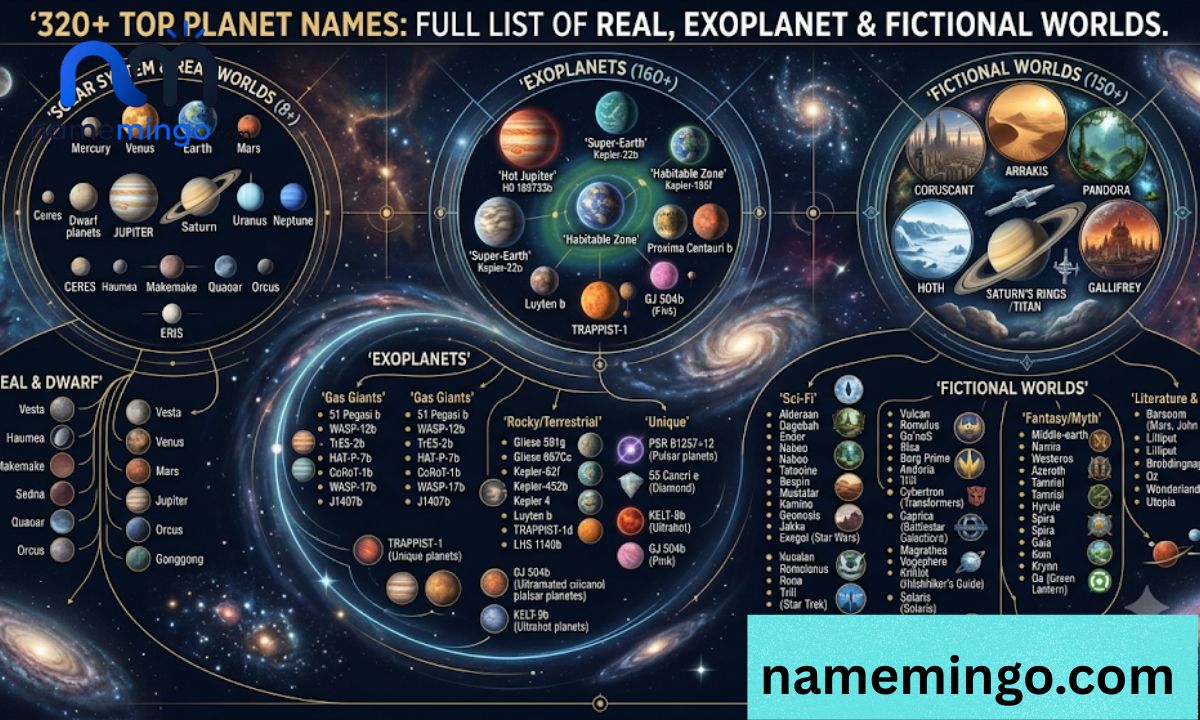
Planets have fascinated people for thousands of years. From the glowing dots we see in the night sky to strange new worlds found by telescopes, planets carry names full of meaning and mystery. Every name tells a small story about how we see space.
Our own solar system gave us the first planet names. Mercury, Venus, Mars, and the rest come from old Roman gods. These names have stayed with us for centuries and still feel familiar today.
Beyond our solar system, scientists keep finding new exoplanets. These distant worlds often get scientific codes, but some also earn creative names. Movies, books, and games add even more planet names, giving us a rich mix of real and fictional worlds to explore.
Planets in the Solar System in Order
- Mercury :The closest planet to the Sun. It is small, rocky, and very hot in the day.
- Venus :The second planet from the Sun. It has thick clouds and a very hot surface.
- Earth :Our home planet. It is the only known planet with life.
- Mars :Known as the Red Planet. It has a dusty, rusty colored surface.
- Jupiter :The largest planet in the solar system. It is a giant ball of gas.
- Saturn :Famous for its bright, wide rings. It is also a gas giant.
- Uranus :A cold, icy planet that spins on its side. It has a pale blue green color.
- Neptune :The farthest planet from the Sun. It is dark blue and very windy.
Planets in Order of Size
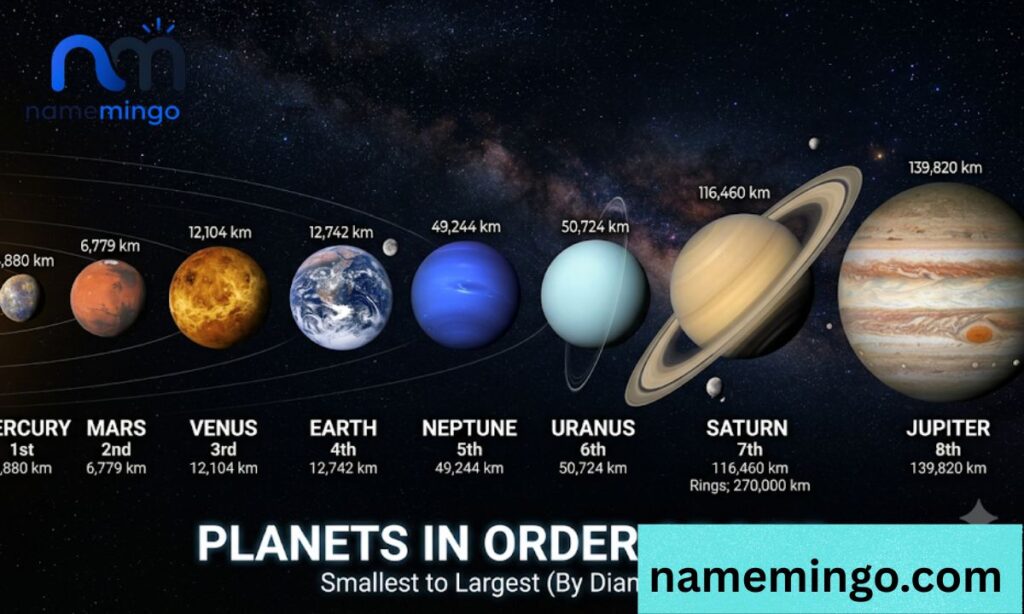
- Jupiter :The biggest planet by far. It could fit over a thousand Earths inside it.
- Saturn :The second largest planet. It is famous for its huge ring system.
- Uranus :The third largest planet. It is an icy giant with a tilted spin.
- Neptune :Slightly smaller than Uranus. It has the strongest winds in the solar system.
- Earth :The largest rocky planet. It is home to oceans, land, and life.
- Venus :Just a bit smaller than Earth. It is often called Earth’s twin in size.
- Mars :About half the size of Earth. It has the tallest volcano in the solar system.
- Mercury :The smallest planet of all. It is barely bigger than our Moon.
Who Named the Planets
Ancient people named the five planets they could see with just their eyes. Mercury, Venus, Mars, Jupiter, and Saturn all carry the names of Roman gods. Uranus and Neptune were found later using telescopes, so astronomers gave them names too. They kept the tradition and picked names from Roman and Greek myths. Earth is the one planet that does not follow this Roman naming pattern. Its name comes from old English and German words instead of a god’s name.
How Did Planet Saturn Get Its Name
Saturn was named after the Roman god of farming, time, and wealth. Ancient stargazers saw it move slowly across the sky and thought of this powerful god. The slow orbit of Saturn matched the calm, patient nature people imagined for this god. This is why the name has stayed the same for thousands of years. Saturn was also the father of Jupiter in Roman myths. This made the naming feel fitting, since Jupiter is the next planet out from Saturn.
How Did Mercury Planet Get Its Name
Mercury moves faster around the Sun than any other planet. Ancient Romans named it after their swift messenger god, Mercury. The real Mercury planet zips through the sky quickly when viewed from Earth. This fast movement reminded early astronomers of a running messenger. The god Mercury was known for speed and quick thinking. That is exactly why the tiny, fast orbiting planet got his name.
Who Named Planet Earth Earth
No single person named Earth. The name grew slowly from old English and Germanic words over many centuries. The word “eorþe” in Old English simply meant ground or soil. Over time, this word changed and became “Earth.” Every other planet got a name from Roman mythology, but Earth did not. It kept a simple, everyday word instead of a god’s name.
Who Named the Earth Planet
Just like before, there was no single naming event for Earth. Language experts say the name formed naturally as people talked about the ground beneath them. Early cultures used many words for soil, land, and ground in their own languages. English speakers eventually settled on “Earth” as the planet’s name. This makes Earth unique among the planets. Its name reflects everyday language, not myths about gods in the sky.
Why Planet Names Matter?
Planet names help scientists and the public talk about space clearly. A clear name makes it easy to study, remember, and share information about a world. Names also carry culture, history, and imagination. A good planet name can make a distant, unknown place feel real and interesting to people. In fiction, planet names help build a whole story world. A well chosen name can hint at a planet’s danger, beauty, or mystery before we know anything else.
Unique Planet Names
- Kepler 16b :This exoplanet orbits two stars instead of one. It looks like something from a science fiction movie.
- Kepler 452b :Nicknamed Earth’s “cousin.” It is one of the most Earth like exoplanets found so far.
- TRAPPIST 1e :One of seven planets circling a small, cool star. It sits in a zone where water could exist.
- GJ 1214b :Known as a possible “water world.” Scientists think it may be covered in deep oceans.
- HD 209458 b (Osiris) :The first exoplanet found losing its atmosphere. It is named after an Egyptian god.
- 51 Pegasi b (Dimidium) :The first exoplanet discovered around a normal star. Its name means “half,” linked to its mass.
- 55 Cancri e (Janssen) :Sometimes called the “diamond planet.” Extreme heat and pressure may turn its surface into carbon crystals.
- WASP 12b :A planet being slowly eaten by its own star. It is stretched into an egg like shape by gravity.
- WASP 17b :One of the puffiest exoplanets known. It is larger than Jupiter but much lighter in weight.
- HAT P 7b :A planet with skies that may rain liquid rubies and sapphires. Its winds are incredibly fast and fierce.
- PSR B1257+12 b (Draugr) :One of the first exoplanets ever confirmed. It orbits a dead, spinning star called a pulsar.
- PSR B1257+12 c (Poltergeist) :Named after a ghost, since it circles a “dead” star. It was one of the earliest exoplanet discoveries.
- PSR B1257+12 d (Phobetor) :Named after a Greek god of nightmares. It shares its strange pulsar system with two sibling planets.
- Fomalhaut b (Dagon) :One of the first exoplanets actually photographed. It is named after an ancient sea god.
- Upsilon Andromedae b (Saffar) :A hot gas giant close to its star. Its name comes from a figure in old Arabic tales.
- Upsilon Andromedae c (Samh) :The middle planet in a three planet system. It shares its star with two sibling worlds.
- Upsilon Andromedae d (Majriti) :The outermost of its three planet family. Its name honors a historic Andalusian scholar.
- 16 Cygni Bb (Amateru) :A gas giant with a very stretched, oval orbit. Its name comes from an old Japanese word for heaven.
- Pollux b (Thestias) :One of the closer exoplanets to Earth. It orbits a bright star visible in the night sky.
- Epsilon Eridani b (AEgir) :A young gas giant in a nearby star system. It is named after a Norse sea god.
- HD 149026 b (Tadmor) :A dense, hot planet with a large rocky core. Its name comes from an ancient desert city.
- 14 Herculis b (Veritate) :A massive planet with a long, slow orbit. Its name means “truth” in Latin.
- Kepler 10b :One of the first confirmed rocky exoplanets. It is so close to its star that it may be covered in lava.
- Kepler 37b :One of the smallest exoplanets ever found. It is even smaller than our own Moon.
- Kepler 90i :Part of a system with eight known planets. That makes it a rare match for our own solar system’s planet count.
- K2 18b :A planet where scientists have looked for signs of a possible atmosphere. It lies in its star’s habitable zone.
- LHS 1140b :A rocky “super Earth” that may hold onto its atmosphere. It is a strong candidate in the search for habitable worlds.
- TOI 700d :The first Earth sized planet found by the TESS telescope in a habitable zone. It could have the right temperature for liquid water.
- TOI 700e :A slightly smaller sibling planet in the same system as TOI 700d. It also sits in a zone that could support water.
- GJ 667Cc :A planet in a system with three stars. It orbits in a zone that could allow liquid water.
- HD 40307g :A super Earth that may have a stable, comfortable climate. It does not appear to be locked facing one side to its star.
- OGLE 2005 BLG 390Lb :Found using a rare method called gravitational microlensing. It is a cold, icy world far from its star.
- CoRoT 7b :One of the first small, rocky exoplanets discovered. Its dayside may be hot enough to melt rock.
- Proxima Centauri b :The closest known exoplanet to our solar system. It orbits the nearest star to the Sun.
- Proxima Centauri c :A second, more distant planet in the same nearby star system. It takes much longer to complete one orbit.
- Gliese 581g :Once called one of the most Earth like planets found. Its existence is still debated by scientists today.
- Gliese 876 d :A small, dense planet close to its star. It helped scientists study low mass exoplanets early on.
- WASP 121b :An extremely hot planet with metal clouds. Its atmosphere may even contain vaporized iron.
- HD 189733 b :A bright blue exoplanet with fierce winds. Scientists believe it may rain glass sideways.
- Kepler 22b :One of the first planets confirmed in a habitable zone by Kepler. It is larger than Earth but still rocky like in nature.
Cool Planet Names
- Tatooine :A desert planet with two suns in the sky. It comes from the Star Wars universe.
- Arrakis :A harsh desert world covered in sand and giant creatures. It is the setting of the Dune story.
- Vulcan :A logical, dry planet from Star Trek. It is home to a calm, reason driven alien species.
- Krypton :The doomed home planet of Superman. It was destroyed shortly after he was born.
- Pandora :A lush, glowing jungle moon from the movie Avatar. It is full of strange plants and creatures.
- Namek :A green, alien world from Dragon Ball. It has three moons and a peaceful native race.
- Cybertron :A metal planet built by robots. It is the home world of the Transformers.
- Alderaan :A peaceful planet destroyed in Star Wars. It was known for its beauty before it was gone.
- Coruscant :A planet completely covered by one giant city. It serves as a capital world in Star Wars.
- Endor :A forest moon full of tall trees. It is home to small, furry creatures called Ewoks.
- Hoth :A frozen, icy planet from Star Wars. It is covered in snow and dangerous creatures.
- Naboo :A calm, green planet with shining cities. It appears throughout the Star Wars prequels.
- Mustafar :A fiery volcanic planet covered in lava rivers. It is the site of a famous Star Wars battle.
- Kamino :A stormy ocean world with no land in sight. It is known for its cloning facilities in Star Wars.
- Geonosis :A rocky, dusty planet with giant insect like beings. It appears in the Star Wars films.
- Mandalore :A war torn planet with a strong warrior culture. It is central to Star Wars stories about bounty hunters.
- Jakku :A sandy, wrecked planet full of old starship parts. It appears in the newer Star Wars movies.
- Ego :A living planet from the Marvel universe. It can shape and control its own surface.
- Xandar :A bright, advanced planet from Marvel comics. It is home to a powerful space police force.
- Zenn La :A once peaceful planet from Marvel comics. It was later drained of its energy by a cosmic being.
- Genosha :An island nation planet like setting in Marvel comics. It plays a big role in X Men stories.
- Barsoom :The fictional name for Mars in old adventure novels. It comes from the John Carter book series.
- Gallifrey :The home world of the Time Lords. It is a key planet in the Doctor Who universe.
- Trantor :A planet completely covered by a single massive city. It appears in Isaac Asimov’s Foundation series.
- Solaris :A mysterious planet covered by a strange living ocean. It comes from the classic novel Solaris.
- Dagobah :A swampy, misty planet full of strange creatures. It is where Yoda hides in Star Wars.
- Bespin :A giant gas planet with a floating mining city. It appears in The Empire Strikes Back.
- Kashyyyk :A tall, forested planet with giant trees. It is the home world of the Wookiees in Star Wars.
- Vogsphere :A strange, ugly planet home to a bureaucratic alien race. It appears in The Hitchhiker’s Guide to the Galaxy.
- Magrathea :A legendary planet building world from science fiction. It appears in The Hitchhiker’s Guide to the Galaxy.
- Camazotz :A dark, controlled planet ruled by one giant brain. It appears in A Wrinkle in Time.
- Melmac :The fictional home planet of a TV alien character. It was destroyed in the sitcom’s storyline.
- Rura Penthe :A frozen prison planet from Star Trek. It is known as a harsh, icy place of punishment.
- Qo’noS :The home world of the Klingons in Star Trek. It is a rugged, warrior focused planet.
- Risa :A tropical pleasure planet from Star Trek. It is known as a popular vacation spot.
- Ferenginar :A rainy, trade focused planet from Star Trek. It is home to a species obsessed with profit.
- Betazed :A peaceful planet known for its telepathic people. It appears throughout Star Trek: The Next Generation.
- Cardassia Prime :A dry, harsh planet from Star Trek. It is home to a militaristic alien society.
- Bajor :A spiritual planet with a deep religious culture. It plays a central role in Star Trek: Deep Space Nine.
- Romulus :A secretive, shadowy planet from Star Trek. It is home to a proud and cunning alien species.
Beautiful Planet Names
- Titan :Saturn’s largest moon, with thick orange haze. It has rivers and lakes made of liquid methane.
- Europa :One of Jupiter’s icy moons. Scientists believe a hidden ocean lies beneath its frozen shell.
- Ganymede :The largest moon in the solar system. It even has its own weak magnetic field.
- Callisto :One of Jupiter’s most heavily cratered moons. Its ancient, scarred surface makes it look striking.
- Io :A fiery, volcanic moon of Jupiter. It is the most volcanically active body in the solar system.
- Enceladus :A small, icy moon of Saturn. It shoots beautiful jets of water vapor into space.
- Mimas :A moon of Saturn with one giant crater. It looks a bit like a famous fictional space station.
- Rhea :Saturn’s second largest moon. It is icy, quiet, and covered in craters.
- Iapetus :A two toned moon of Saturn. One side is bright white, and the other is dark black.
- Dione :A bright, icy moon of Saturn. It has long, wispy streaks across its surface.
- Tethys :Another icy moon of Saturn. It has a huge, deep canyon stretching across it.
- Triton :Neptune’s largest moon, with a pinkish frosty surface. It orbits backward compared to the planet’s spin.
- Miranda :A small, strange moon of Uranus. It has some of the tallest cliffs in the solar system.
- Ariel :A bright, icy moon of Uranus. It has a smooth, reflective surface.
- Umbriel :One of the darkest moons of Uranus. It is covered in old, faded craters.
- Titania :The largest moon of Uranus. It is named after a fairy queen from an old play.
- Oberon :Another large moon of Uranus. It is named after a fairy king from the same old play.
- Charon :Pluto’s largest moon. It is so big that Pluto and Charon almost orbit each other like a pair.
- Nix :A small moon of Pluto. It is named after a goddess of darkness.
- Hydra :Another small moon orbiting Pluto. It is named after a many headed mythical serpent.
- Styx :A tiny moon of Pluto. It shares its name with a river from the underworld in myth.
- Kerberos :A small, dim moon of Pluto. It is named after a mythical three headed guard dog.
- Ceres :The largest object in the asteroid belt. It is also classified as a dwarf planet.
- Pluto :A small, icy dwarf planet at the edge of the solar system. It was once called the ninth planet.
- Eris :A distant dwarf planet, almost as large as Pluto. Its discovery led to new debates about planet definitions.
- Haumea :An oddly shaped dwarf planet that spins very fast. It looks stretched, almost like an egg.
- Makemake :A reddish dwarf planet in the outer solar system. It is named after a creation god.
- Sedna :A very distant, reddish dwarf planet candidate. It takes thousands of years to orbit the Sun once.
- Quaoar :A distant icy world with a thin ring. It is named after a creation god from Native American mythology.
- Orcus :A dwarf planet that shares a similar orbit pattern with Pluto. It is sometimes called Pluto’s “anti twin.”
- Salacia :A cold, icy dwarf planet candidate far from the Sun. It is named after a Roman goddess of the sea.
- Gonggong :A distant reddish world with its own small moon. It is named after a Chinese water god.
- Ixion :A distant icy body beyond Neptune. It is named after a figure punished in Greek mythology.
- Varda :A far off icy world with a red, dusty surface. It is named after a beloved character from Tolkien’s writing.
- Chaos :A distant, icy trans Neptunian object. Its name reflects the ancient idea of the universe’s early formless state.
- Deucalion :A distant minor planet named after a mythical flood survivor. It orbits far out in the solar system.
- Chariklo :The largest known centaur object, orbiting between Saturn and Uranus. It even has its own set of thin rings.
- Hygiea :A large object in the asteroid belt, sometimes considered dwarf planet like. It is named after a goddess of health.
- Pallas :One of the largest asteroids in the belt. It is named after a Greek goddess of wisdom.
- Vesta :A bright, large asteroid visible sometimes without a telescope. It is named after a Roman goddess of the hearth.
Celestial Planet Names in Order
- Ceres :The closest dwarf planet to the Sun, sitting in the asteroid belt. It is the smallest known dwarf planet.
- Pluto :Once the ninth planet, now the most famous dwarf planet. It lies far beyond Neptune’s orbit.
- Haumea :A fast spinning, egg shaped dwarf planet. It lies in the icy Kuiper Belt region.
- Makemake :The second brightest object in the Kuiper Belt after Pluto. It has a reddish, icy surface.
- Eris :One of the most massive known dwarf planets. It orbits very far from the Sun.
- Sedna :A dwarf planet candidate with an extremely long, stretched orbit. It travels farther out than almost anything else known.
- Quaoar :A mid sized icy body with a surprising thin ring. It orbits within the Kuiper Belt.
- Orcus :A dwarf planet that mirrors Pluto’s orbit pattern. It has a large moon of its own.
- Salacia :A distant, dark icy body in the outer solar system. It also has its own moon.
- Gonggong :A reddish dwarf planet candidate far past Neptune. It has a highly tilted orbit.
- Ixion :A large trans Neptunian object without a confirmed moon. It travels in a similar zone to Pluto.
Planets Names in Order
- 51 Pegasi b :The first exoplanet confirmed around a Sun like star. This discovery opened up the entire field of exoplanet research.
- PSR B1257+12 b :One of the very first exoplanets ever confirmed. It orbits a fast spinning dead star.
- PSR B1257+12 c :A sibling planet in the same early discovered system. It orbits a pulsar left behind after a star’s death.
- 55 Cancri e :A hot, rocky planet close to its star. It is famous for possibly having a carbon rich, gem like interior.
- HD 209458 b :The first exoplanet observed passing directly in front of its star. This method became key to future discoveries.
- Gliese 581g :A planet once thought to be a strong Earth like candidate. Its confirmation is still debated among scientists.
- Kepler 22b :One of the first planets confirmed inside a habitable zone by the Kepler telescope. It sparked huge public interest.
- Kepler 452b :Often nicknamed Earth’s older cousin. It orbits a star similar in age and type to our Sun.
- Proxima Centauri b :The nearest known exoplanet to our solar system. It orbits the closest star to the Sun.
- TRAPPIST 1e :Part of a famous seven planet system. It sits in a zone that could support liquid water.
- K2 18b :A planet studied for possible atmospheric water vapor. It orbits a small, cool red star.
- TOI 700d :The first Earth sized habitable zone planet found by the newer TESS telescope. It renewed excitement in the search for other Earths.
9 Planets Name with Images
- Mercury :The smallest and fastest planet in the solar system. It has no moons and almost no atmosphere.
- Venus :The hottest planet due to its thick, trapping atmosphere. It spins in the opposite direction from most planets.
- Earth :The only planet known to support life. It has liquid water covering most of its surface.
- Mars :Known as the Red Planet because of its rusty soil. It has the largest volcano in the solar system.
- Jupiter :The largest planet, with a famous giant storm called the Great Red Spot. It has dozens of known moons.
- Saturn :Best known for its wide, bright rings made of ice and rock. It is light enough to almost float in water.
- Uranus :A tilted ice giant that spins on its side. It has a faint ring system of its own.
- Neptune :The windiest planet, with storms faster than sound. It has a deep blue color from methane in its atmosphere.
- Pluto :Once called the ninth planet, now known as a dwarf planet. It has a large moon named Charon almost half its size.
Celestial Planet Name Ideas
- Astralis :A name that sounds open and endless, like deep space itself. It works well for a bright, star filled world.
- Novaris :Inspired by the word “nova,” meaning a bright star explosion. It suits a fiery, dramatic looking planet.
- Lumaris :A soft, glowing name that feels calm and gentle. It fits a planet known for soft light.
- Empyros :A grand, powerful sounding name tied to the idea of the heavens. It suits a planet meant to feel important.
- Solmara :A warm name that blends “sun” and a sea like ending. It fits a bright, ocean covered world.
- Vesperine :A quiet, evening sky sort of name. It suits a calm planet lit by a soft twilight glow.
- Astrium :A short, clean, science fiction style name. It works well for a sleek, futuristic planet.
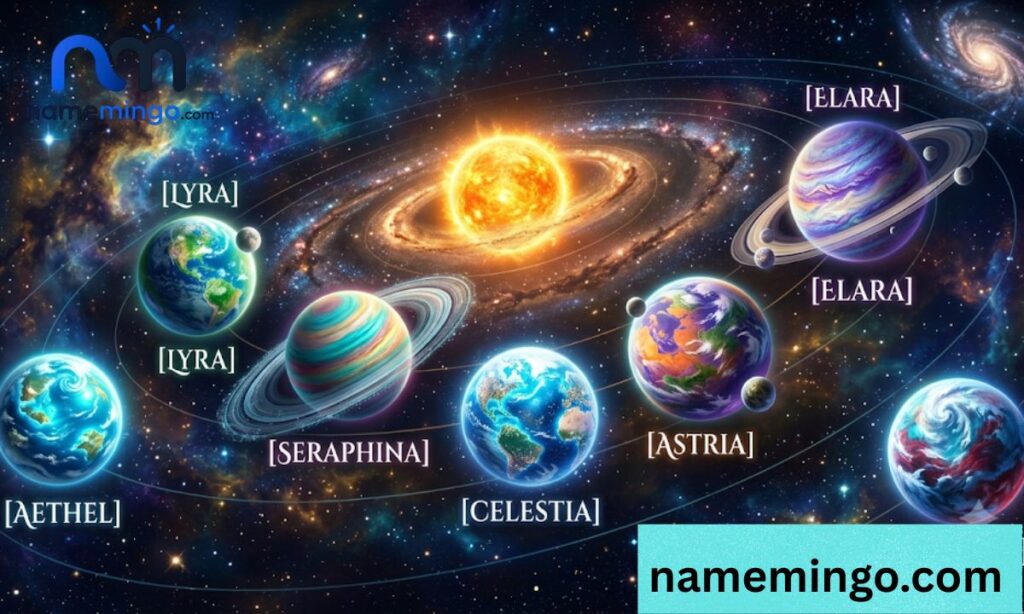
- Celestia :A classic, elegant celestial sounding name. It suits a peaceful, dreamlike world.
- Aurelia Prime :A golden, regal sounding name with a royal feel. It fits a planet known for wealth or beauty.
- Nebulon :A cloudy, mysterious name linked to nebulas. It suits a planet surrounded by colorful gas clouds.
- Starhaven :A cozy yet cosmic name that feels safe. It fits a peaceful planet used as a resting place.
- Skyros :A short, sharp name with a sky like sound. It suits an airy, open, high atmosphere world.
- Halcyon :A calm, peaceful sounding name from old poetry. It fits a quiet, balanced planet.
- Zenithar :A strong name linked to “zenith,” meaning the highest point. It suits a powerful, central world in a story.
Fantasy Planet Names
- Eldoria :A grand, old sounding name fit for a legendary world. It suits a planet full of ancient magic.
- Thornveil :A name that hints at danger hidden behind beauty. It fits a planet covered in strange, thorny forests.
- Mystralon :A mysterious name blending “mystery” and a strong ending. It suits a planet full of secrets.
- Drakmoor :A bold, dragon like name with a heavy sound. It fits a rugged, wild fantasy world.
- Faelindra :A light, fairy tale style name. It suits a magical, glowing forest planet.
- Ravenspire :A dark, dramatic name with a gothic feel. It fits a shadowy, mysterious world.
- Wyrmhold :A strong name tied to old dragon legends. It suits a planet known for powerful creatures.
- Sylvaris :A nature inspired name with a forest like sound. It fits a green, tree covered planet.
- Emberfall :A warm, fiery name that feels dramatic. It suits a volcanic or war torn fantasy world.
- Frosthaven :A cold, icy name that still feels safe. It fits a snowy planet with a peaceful side.
- Duskmere :A quiet, shadowy name tied to evening light. It suits a calm, twilight covered world.
- Ironspire :A strong, solid sounding name. It fits a planet known for tall towers or metal cities.
- Moonshade :A soft, mysterious name linked to moonlight. It suits a planet lit mostly by moons.
- Stormrend :A powerful, harsh sounding name. It fits a stormy, dangerous fantasy world.
Also Read This : 400+ Inspiring Baby Names That Mean Faith for Boys and Girls
Alien Planet Names
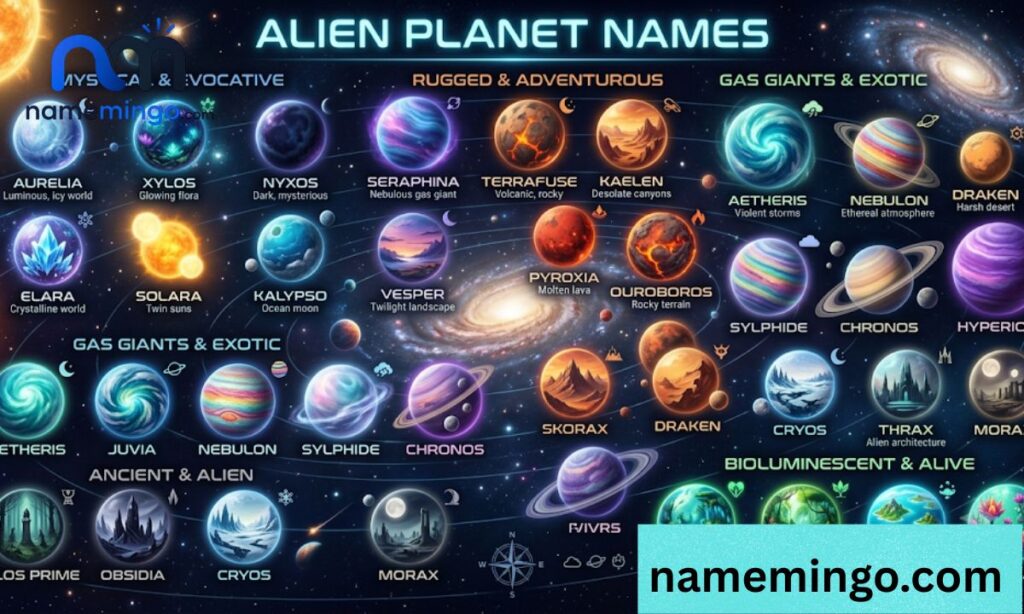
- Xelara :A sharp, alien sounding name with an easy rhythm. It suits a strange, unfamiliar world.
- Vorkuun :A heavy, rough sounding name. It fits a rugged, harsh alien planet.
- Zyphex :A short, buzzing name that feels technological. It suits a planet with advanced alien life.
- Krallos :A strong, growling sort of name. It fits a planet home to a fierce alien species.
- Thexia :A smooth, flowing alien name. It suits a calm, elegant alien world.
- Ny’Vahr :A name with a sharp break in the middle, giving it an exotic sound. It fits a mysterious alien culture.
- Grellith :A dense, unusual sounding name. It suits a swampy or thick atmosphere alien planet.
- Orbyxa :A round, orbit like sounding name. It fits a planet known for its strange shape.
- Quintor 9 :A numbered, scientific style name. It suits a planet discovered as part of a research mission.
- Zetraxis :A bold, powerful sounding alien name. It fits a planet ruled by a strong alien empire.
- Vantrix :A sleek, modern alien name. It suits a technologically advanced alien world.
- Ossek Prime :A firm, formal sounding name. It fits a planet that serves as an alien home world.
- K’Thara :A name with a soft apostrophe break, giving it an alien feel. It suits a spiritual or ritual based alien culture.
- Muraxi :A smooth, easy to say alien name. It fits a peaceful, quiet alien planet.
Stellar Planet Names
- Stellaron :A strong name tied directly to the word “stellar.” It suits a bright, star like planet.
- Novaheim :A name blending “nova” with an old world ending. It fits a planet known for sudden bursts of light.
- Astrapax :A powerful name linked to stars and energy. It suits a planet near an active star system.
- Solvane :A warm, sun linked name. It fits a planet that glows with reflected starlight.
- Pulsara :A name inspired by pulsars, fast spinning dead stars. It suits a planet with a rhythmic, glowing pattern.
- Corondril :A name that echoes “corona,” the bright ring around a star. It fits a planet with a glowing outer layer.
- Luminex :A bright, glowing name with a technical sound. It suits a planet known for constant light.
- Radiantia :A soft, elegant name tied to “radiant.” It fits a planet admired for its beauty.
- Starforge :A strong, industrial sounding name. It suits a planet linked to building or creation myths.
- Solacia :A calm name blending “sun” and comfort. It fits a peaceful, star warmed world.
- Novastra :A dramatic name tied to bursts of starlight. It suits a planet with a dramatic history.
- Astellon :A balanced, star themed name. It fits a stable, well known planet in a story.
- Brightspire :A tall, glowing name. It suits a planet with tower like glowing formations.
- Nebulyra :A dreamy name blending “nebula” and music. It fits a planet surrounded by colorful space clouds.
Ring Planet Names
- Ringhaven :A safe, welcoming name for a ringed world. It suits a planet known as a peaceful stop for travelers.
- Coronet Prime :A regal name tied to a ring shaped crown. It fits a grand, important ringed planet.
- Halowyn :A soft name linked to the word “halo.” It suits a planet with a glowing ring.
- Orbitring :A direct, descriptive name. It fits a planet clearly known for its ring system.
- Ringspire :A tall, elegant name. It suits a planet with rings that seem to reach upward.
- Bandara :A smooth name linked to the idea of a “band” or ring. It fits a planet with several ring layers.
- Circlon :A simple, round sounding name. It suits a planet shaped by its perfect ring.
- Ringveil :A mysterious name suggesting rings that hide something. It fits a planet with secrets beneath its rings.
- Coronara :A bright, crown like name. It suits a planet known for a shining ring at sunset.
- Loopstar :A playful, easy name. It fits a smaller planet with a simple, thin ring.
- Ringmoor :A rugged name that mixes rings with wild landscapes. It suits a planet with a rough surface and rings above.
- Ovalis :A shape based name for a slightly uneven ring. It fits a planet whose ring is not perfectly round.
- Beltara :A name linked to “belt,” fitting a wide asteroid style ring. It suits a rocky, ringed planet.
- Ringholm :A steady, home like name. It fits a ringed planet that feels stable and lived in.
Gleaming Planet Names
- Glimmeris :A soft, sparkling name. It suits a planet with a shiny, glowing surface.
- Radianth :A strong name tied to “radiant.” It fits a planet known for bright light.
- Shimmeron :A smooth, shining name. It suits a planet that seems to shimmer from a distance.
- Luster Prime :A polished, elegant name. It fits a planet admired for its shiny appearance.
- Glowveil :A gentle name suggesting hidden light. It suits a planet that glows softly through clouds.
- Sheenara :A light, glossy sounding name. It fits a smooth, reflective planet.
- Sparkhaven :A bright, welcoming name. It suits a planet known for glittering landscapes.
- Brightoria :A bold, glowing name. It fits a planet that stands out from far away.
- Glintara :A quick, flashing sort of name. It suits a planet with sudden bursts of light.
- Polara :A cool, icy shine name. It fits a bright, frozen, gleaming planet.
- Sheenspire :A tall, shining name. It suits a planet with glowing towers or peaks.
- Glaziron :A glassy, smooth sounding name. It fits a planet with a mirror like surface.
- Twinklos :A light, playful name. It suits a small planet known for a twinkling glow.
- Glowmere :A calm, gentle name. It fits a peaceful planet lit by a soft, steady glow.
Cute Planet Names
- Pudlyx :A soft, round sounding name. It suits a small, friendly looking planet.
- Bumbleon :A playful, buzzing name. It fits a cheerful, lively little world.
- Snugglos :A cozy, comforting name. It suits a warm, welcoming planet.
- Fluffara :A light, fluffy sounding name. It fits a planet with soft, cloud like features.
- Squishla :A bouncy, fun name. It suits a small, soft looking planet.
- Twinklebub :A cheerful, sparkly name. It fits a bright, happy little planet.
- Puffington :A round, gentle name. It suits a cloud covered, puffy looking world.
- Marshmara :A sweet, soft name linked to marshmallows. It fits a pale, fluffy planet.
- Cuddleoid :A warm, friendly name. It suits a planet that feels safe and comforting.
- Bubblewik :A light, bouncy name. It fits a small planet with a bubble like shape.
- Dreamypop :A soft, whimsical name. It suits a pastel colored, dreamy little world.
- Pipsqueakon :A tiny, playful name. It fits the smallest planet in a fictional system.
- Snoozara :A calm, sleepy sounding name. It suits a quiet, slow moving planet.
- Wobblet :A wobbly, cute name. It fits a small planet with an uneven, playful orbit.
Greek Planet Names
- Hyperion :A Titan linked to light and watchfulness in Greek myth. It suits a bright, all seeing planet.
- Cronus :The Titan ruler of time in Greek mythology. It fits a powerful, ancient feeling planet.
- Selene :The Greek goddess of the Moon. It suits a pale, glowing, moon like planet.
- Helios :The Greek god who drives the sun across the sky. It fits a hot, sun bright planet.
- Eos :The Greek goddess of the dawn. It suits a planet known for soft morning colored skies.
- Nyx :The Greek goddess of the night. It fits a dark, star filled planet.
- Gaia :The Greek goddess representing the Earth itself. It suits a green, life filled planet.
- Ouranos :The Greek god representing the sky. It fits a planet covered in endless clouds.
- Chronos :Linked to the idea of time in Greek thought. It suits a planet tied to time based story themes.
- Erebus :The Greek god of deep darkness and shadow. It fits a dim, mysterious planet.
- Aether :The Greek personification of the upper sky’s bright air. It suits a clear, high atmosphere planet.
- Hemera :The Greek goddess of daylight. It fits a bright, sunny, cheerful planet.
- Themis :The Greek goddess of order and fairness. It suits a balanced, orderly planet society.
- Iris :The Greek goddess of the rainbow. It fits a colorful, multi hued planet.
Funny Planet Names
- Planet McPlanetface :A joke name poking fun at internet naming trends. It suits a lighthearted, silly story world.
- Blorptron :A silly, made up sound of a name. It fits a goofy, cartoon style planet.
- Wobblonia :A wobbly, clumsy sounding name. It suits a planet known for shaky, uneven ground.
- Snorkelax :A funny name that sounds like snorkeling gear. It fits a watery, odd shaped planet.
- Gigglestar :A cheerful, laughing sort of name. It suits a happy, comedic planet.
- Dorkulon :A playful, nerdy sounding name. It fits a planet full of clumsy but lovable characters.
- Chuckleor :A light, joking name. It suits a comedic planet in a lighthearted story.
- Wackaria :A wild, silly sounding name. It fits a chaotic, fun loving planet.
- Bellylaugh Beta :A goofy, giggly name. It suits a planet built entirely around comedy.
- Bloopington :A clumsy, funny sounding name. It fits a planet where mistakes are common and harmless.
- Noodleon :A silly, floppy sounding name. It suits a bendy, odd shaped planet.
- Goofaxis :A playful mix of “goofy” and a space sounding ending. It fits a light comedy setting.
- Zanytron :A wacky, robotic sounding name. It suits a chaotic, unpredictable planet.
- Snickerdoodle IX :A sweet, funny name borrowed from a cookie. It fits a cozy, comedic little world.
Also Read This : 262+Celestial & Universe Names for Boys, Girls, and Unisex
Weird Planet Names
- Glorptexa :An odd, hard to pronounce name. It suits a strange, unpredictable planet.
- Vexnull :A cold, blank sounding name. It fits a planet that feels empty or eerie.
- Thrimbor :A heavy, unusual name. It suits a planet with strange gravity or terrain.
- Oozara :A slippery, sticky sounding name. It fits a swampy or slime covered planet.
- Warplex :A twisted, bending sort of name. It suits a planet with strange, warped landscapes.
- Skrenox :A sharp, scratchy sounding name. It fits a rocky, jagged, unusual world.
- Fungaris :A name linked to fungus and mold. It suits a planet covered in strange growths.
- Slimewick :A gooey, odd sounding name. It fits a wet, sticky planet surface.
- Twistara :A bent, twisting name. It suits a planet with unusual, curling landforms.
- Muckveil :A murky, hidden sounding name. It fits a swampy planet covered in fog.
- Bogsprawl :A wide, muddy sounding name. It suits a planet covered mostly in wetlands.
- Cragnoth :A rough, jagged name. It fits a rocky, strange shaped planet.
- Slugmoor :A slow, slimy sounding name. It suits a quiet, damp, odd little world.
- Wartex :A short, strange, buzzing name. It fits a planet with an unclear, mysterious purpose.
Random Planet Names
- Kelvorin :A neutral, easy to say name. It suits almost any type of fictional planet.
- Trandash :A quick, energetic sounding name. It fits a fast moving or lively planet.
- Ploxmara :A soft, rolling name. It suits a calm, unclear purpose planet.
- Yendor :A short, mysterious name. It fits a planet with an unknown history.
- Braxel :A sharp, simple name. It suits a small, minor planet in a larger story.
- Quintavion :A longer, formal sounding name. It fits a planet with an important role.
- Molvex :A blunt, technical sounding name. It suits a planet used mainly for mining or industry.
- Sarnith :A smooth, balanced name. It fits a peaceful, background planet.
- Vindara :A flowing, elegant name. It suits a planet with a gentle climate.
- Cletor Prime :A formal, official sounding name. It fits a planet that serves as a hub or capital.
- Ombrix :A shadowy, quiet name. It suits a dim, low light planet.
- Talveth :A soft, old sounding name. It fits a planet with a long, quiet history.
- Ruskara :A warm, earthy name. It suits a dusty, reddish planet.
- Nyxelon :A dark, nighttime linked name. It fits a planet often shown at night in a story.
Planet Name Generators
A planet name generator is a simple tool that mixes sounds, prefixes, and endings to create new names. Many are free online tools made for writers, gamers, and worldbuilders. These tools usually let you pick a style, such as alien, fantasy, or futuristic. This makes it easy to get a name that matches the mood of your story. Generators are a great starting point, not always a final answer. Many creators tweak the generated name slightly until it feels just right.
How to Build Your Own Celestial Planet Name:
Start by choosing a short root word that fits your planet’s mood, like “nova,” “lumin,” or “vex.” This root becomes the base sound of your final name. Next, add a fitting ending, such as ” ara,” ” ion,” ” ith,” or ” oth.” Different endings can make the same root sound soft, powerful, or strange. Finally, say the full name out loud to check how it flows. A good planet name should be easy to say and easy to remember.
Example Combinations
- Astro + ara = Astrara :A star based root with a soft ending. It sounds elegant and calm.
- Nova + ion = Novion :A bright, explosive root with a strong ending. It sounds bold and modern.
- Lumin + os = Luminos :A light based root with a classic ending. It sounds bright and clean.
- Stell + ara = Stellara :A star themed root with a flowing ending. It sounds graceful and open.
- Terr + ion = Terrion :An earth based root with a strong ending. It sounds solid and grounded.
- Sol + ara = Solara :A sun based root with a gentle ending. It sounds warm and friendly.
- Neb + ion = Nebion :A cloud based root with a firm ending. It sounds mysterious yet stable.
- Vex + ara = Vexara :A strange, edgy root with a soft ending. It sounds a little dark but still smooth.
- Cryo + ith = Cryolith :An ice based root with a rock like ending. It sounds cold and solid.
- Pyro + oth = Pyrooth :A fire based root with a heavy ending. It sounds hot and powerful.
- Aer + ion = Aerion :An air based root with a strong ending. It sounds light and airy.
- Mar + ara = Marara :A sea based root with a smooth ending. It sounds watery and calm.
- Umbr + ith = Umbrith :A shadow based root with a firm ending. It sounds dark and mysterious.
- Gale + ion = Galeion :A wind based root with a strong ending. It sounds fast and energetic.
Frequently Asked Questions
What are the names of all 8 planets?
Mercury, Venus, Earth, Mars, Jupiter, Saturn, Uranus, and Neptune.
What is the most famous exoplanet?
Kepler 452b is one of the most famous exoplanets found.
What planet is closest to the sun?
Mercury is the closest planet to the sun.
What is the biggest planet in the universe?
The largest known planet is ROXs 42Bb, a giant exoplanet.
What are some fictional planet names?
Popular ones include Tatooine, Krypton, Pandora, and Arrakis.
Is Pluto still called a planet?
No, Pluto is now classified as a dwarf planet.
Conclusion
Planet names take us from real science to pure imagination. Real planets like Earth and Mars have names from old myths. Exoplanets get short codes like Kepler 452b, since there are too many to name like stories.
Fictional planets are different. Writers pick names that sound bold and strange, like Tatooine or Krypton. These names stick in our minds and make far off worlds feel real, whether they orbit a real star or live only in books and films.

Daniel is the creator of Namemingo.com, a writer guided by curiosity and a deep passion for the stories behind names. With a background in linguistics, cultural history, and name etymology, Daniel transforms complex research into clear, engaging, and easy-to-understand content. His writing invites readers to explore the rich origins, spiritual meanings, and cultural significance hidden within everyday names.







1 thought on “ 320+ Top Planet Names: Full List of Real, Exoplanet & Fictional Worlds”