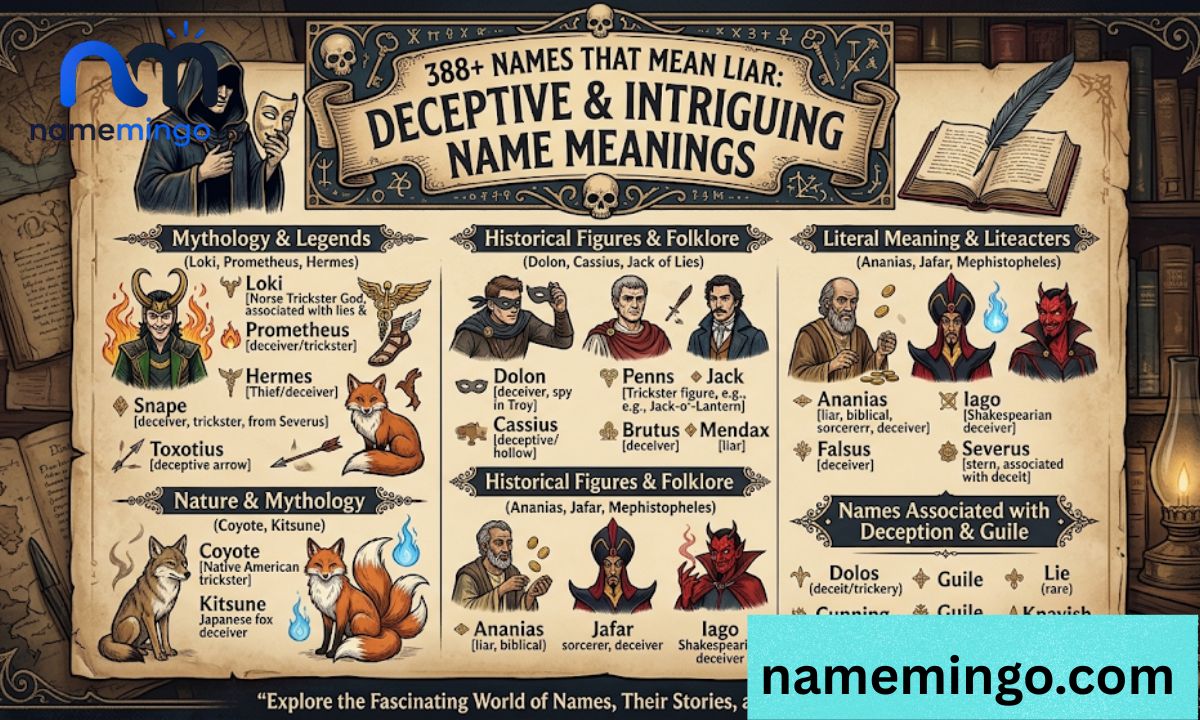
These names come from old myths and languages. Parents once picked names for hidden traits. Some chose names tied to trickery or cunning.
This list explores those intriguing names. You will learn their origins and meanings. Each name has its own unique story.
Names for Liar Characters
Loki : Norse trickster god famous for lies and shapeshifting. His name is forever tied to mischief and cunning.
Iago : Shakespeare’s scheming villain from Othello. His name is now shorthand for calculated betrayal.
Anansi : West African spider trickster known for clever lies. His stories teach lessons through deception.
Sinon : Greek soldier who tricked Troy with a false tale. His lie helped bring down an entire city.
Puck : Mischievous fairy from English folklore. He delights in pranks and playful illusions.
Coyote : Trickster figure across many Native American traditions. He often lies to get his way, with mixed results.
Raven : Trickster spirit from Pacific Northwest legend. He uses cunning words to fool others.
Reynard : Fox hero of medieval European fables. His name became a symbol of clever deceit.
Br’er Rabbit : Folk trickster from Southern American tales. He talks his way out of trouble with sly words.
Hermes : Greek messenger god known for trickery. As an infant, he cleverly lied about stealing cattle.
Eshu : Yoruba trickster spirit who enjoys confusion. He often bends truth to test people’s character.
Maui : Polynesian trickster hero and demigod. He uses tricks and half-truths to help humankind.
Kitsune : Japanese fox spirit known for illusions. Folklore says these spirits trick humans with false forms.
Loge : Old Germanic name linked to Loki. It carries a sense of fire and deception.
Wakdjunkaga : Trickster figure from Ho-Chunk mythology. His tales are full of lies and chaos.
Nanabozho : Ojibwe trickster spirit and teacher. He deceives others while secretly guiding them.
Legba : West African and Vodou spirit of crossroads. He enjoys twisting the truth to test people.
Loptr : Another old name tied to Loki. It reflects his sly, shifting nature.
Scapin : Cunning servant from classic Italian comedy. His name is linked to scheming and trickery.
Autolycus : Greek figure known as “the wolf itself.” He was famous for theft, lies, and trickery.
Names That Mean False Hope
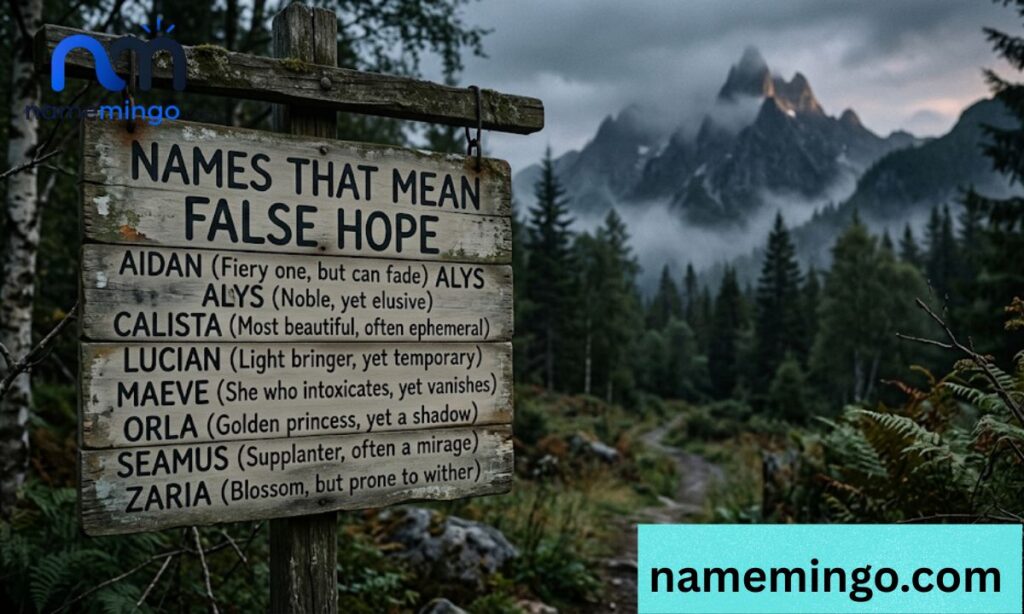
Maya : Sanskrit word for illusion. Some link it to hope that isn’t fully real.
Sarab : Arabic word meaning mirage. It reflects hope that looks close but never arrives.
Elpis : Greek word for hope, which stayed behind in Pandora’s box. Its meaning is sometimes read as hope mixed with false comfort.
Chimera : Mythical creature symbolizing an impossible dream. The word now stands for a hope that isn’t real.
Fata Morgana : Named after a famous mirage phenomenon. It suggests hope that vanishes as you get closer.
Vana : Old word meaning “vain” or “empty.” Some read it as hope without real substance.
Sirena : Related to “siren,” who lured sailors with false promises. Her call symbolizes hope that leads to danger.
Utopia : Greek for “no place.” It represents an ideal hope that may not truly exist.
Nirasha : A Sanskrit-rooted word touching on lost hope. It’s often used poetically for hope that fades.
Trompeuse : French for “deceptive” or “misleading.” It fits a hope that quietly deceives.
Lure : English word for something tempting but misleading. As a name, it suggests hope used to trick.
Mirelle : Sometimes linked in creative naming to “mirage.” Writers use it for hollow or fading hope.
Fantasma : Rooted in “phantom” or “illusion.” It suggests a hope that isn’t grounded in reality.
Wishara : An invented, wish-inspired name. It leans toward hope without a real promise behind it.
Ithildae : An invented, dreamlike fantasy name. Storytellers use it for hope that ultimately turns out empty.
Girl Names That Mean Liar
Apate : Greek personification of deceit itself. Her name is the direct root of the word “apathy” debates aside, she literally means “deceit.”
Circe : Powerful sorceress known for enchantment and trickery. She deceived Odysseus’s men by transforming them.
Medea : Mythical sorceress linked to betrayal and cunning. Her story is full of manipulation and revenge.
Delilah : Biblical figure who deceived Samson. Her name is now linked with charming betrayal.
Jezebel : Biblical queen remembered for manipulation. Her name became a byword for scheming.
Salome : Biblical figure tied to manipulation through charm. Her story involves using influence to get a deadly request granted.
Morgana : Arthurian sorceress known for trickery. She often used illusion against Camelot’s knights.
Lorelei : Siren of Rhine folklore who lured sailors. Her song promised comfort but led to danger.
Melinoe : Greek goddess linked to ghostly deception. She was said to send false, haunting visions.
Ate : Greek goddess of mischief and delusion. She clouds judgment and leads people toward ruin.
Eris : Greek goddess of strife and discord. Her golden apple trick sparked a legendary conflict.
Scylla : Sea monster who lured sailors to danger. Her presence symbolizes deceptive appearances.
Kaguya : Moon princess from Japanese folklore. She cleverly deceived suitors with impossible tasks.
Trixie : Modern name rooted in “trick.” It playfully nods to cleverness and mischief.
Fata : Italian word for “fairy” or “fate,” tied to illusion. Folklore fairies were known for trickery and glamour.
Nyx : Greek goddess of night, keeper of hidden truths. Night itself is often linked to secrets and disguise.
Baba : Short form echoing Baba Yaga, the witch of Slavic tales. She was famous for riddles and deception.
Illusia : Invented modern name rooted in “illusion.” It suggests a nature built on charming untruths.
Vesna Laz : A stylized name blending “spring” with the Slavic root laž (lie). It’s a creative pick for a deceptive character.
What Is a Name That Means Liar?
Jacob is one of the most cited real names linked to deception. In the Bible, Jacob’s name is often connected to “supplanter” or “one who deceives,” tied to the story of him tricking his brother Esau out of a birthright. It remains one of the most authentic, widely recognized examples people search for.
Names That Mean Liar Boy
Jacob : Hebrew name often tied to “supplanter” or trickery. The biblical Jacob deceived his brother Esau.
Laban : Biblical figure who deceived Jacob in return. His name is tied to trickery within family bonds.
Judas : Biblical name forever linked to betrayal. It remains one of history’s strongest symbols of deceit.
Cain : Biblical name tied to deception and guilt. His story is rooted in dishonesty toward his brother.
Dolos : Greek spirit whose name literally means “trickery” or “guile.” He was said to have crafted the first false idol.
Sly : English word-name meaning cunning or crafty. It directly nods to clever deception.
Reynard : Fox-hero name meaning “strong counsel,” used in fables for cleverness and lies. He remains folklore’s ultimate trickster.
Loki : Norse name synonymous with deception. His myths are full of clever, harmful lies.
Hermes : Greek god known for trickery and swift lies. He charmed his way out of trouble as an infant.
Autolycus : Greek name meaning “the wolf itself.” He was famed for theft and lies.
Prometheus : Greek Titan who tricked the gods. His cunning deception brought fire to humanity.
Odysseus : Greek hero known for his clever lies. His cunning schemes, like the Trojan Horse, defined his legend.
Til : Short form referencing Till Eulenspiegel, a German trickster folk hero. He used lies and pranks to expose others’ flaws.
Nick : Old nickname for “Old Nick,” a folk name for a trickster devil figure. It carries a playful, sly undertone.
Wile : Word-based name meaning cunning trick or deception. It fits a sly, clever character.
Guile : Direct word-name meaning “cunning deceit.” It’s used in fiction for calculating characters.
Ganelon : Betrayer figure from the Song of Roland. His name became linked with treachery.
Loge : Old Germanic variant tied to Loki. It shares his fiery, deceptive nature.
Vidar Laug : A stylized Norse-inspired name using laug/lygi, related to lying. It works well for a trickster character.
What Are Some Names That Mean Liar?
Jacob : Often cited for its “supplanter/deceiver” meaning.
Dolos : Greek word directly meaning “trickery.”
Apate : Greek word directly meaning “deceit.”
Reynard : Folklore fox famous for lies.
Sly : English word-name meaning cunning.
Loki : Norse god known for deception.
Delilah : Biblical figure tied to betrayal through deceit.
Guile : Direct word-name meaning calculated deceit.
Name That Means Liar
Dolos stands out as one of the clearest examples. In Greek mythology, Dolos was the personification of trickery and guile, said to have crafted a false statue so convincing it fooled even the gods. His name is essentially the ancient Greek word for deception itself.
Quick Checklist Before Choosing a Trickster or Liar Themed Name
Think about tone first. A name like “Dolos” feels mythic and serious, while “Trixie” feels light and playful.
Check real-world usability. Some names work beautifully in fiction but sound unusual for everyday use.
Consider cultural context. Research a name’s origin so its deceptive meaning fits respectfully into your story or naming choice.
Balance meaning with sound. A name should still feel pleasant to say, even if its meaning is mischievous.
Think about associations. Names like Judas or Jezebel carry strong historical weight that some readers will instantly recognize.
Names That Mean Liar (Girl)
Circe : Sorceress famed for enchanting deception. She turned truth into illusion throughout her myths.
Delilah : Biblical name tied to calculated betrayal. Her charm masked a deceptive plan.
Jezebel : Name symbolizing manipulation and scheming. It remains a strong cultural reference for deceit.
Morgana : Sorceress known for trickery and illusion. She often disguised her true intentions.
Lorelei : Siren whose song promised false comfort. Her legend warns of beautiful deception.
Ate : Goddess of delusion and mischief. She clouds minds and leads them toward false choices.
Eris : Goddess whose trick sparked legendary conflict. Her golden apple remains a symbol of deceptive gifts.
Scylla : Sea monster tied to deceptive danger. Sailors were lured by false safety near her.
Melinoe : Goddess linked to ghostly, false visions. She represents deception born from illusion.
Kaguya : Moon princess known for clever deception. She outwitted suitors with impossible, misleading tasks.
Salome : Figure remembered for manipulative influence. Her request through charm led to tragedy.
Baba Yaga : Witch of Slavic folklore known for riddles. She often tricked visitors who entered her domain.
Fata : Word tied to fairies and illusion. Fairy folklore often involves glamour and deception.
Nyx : Goddess of night and hidden secrets. Darkness itself often symbolizes concealment.
Illusia : Modern invented name rooted in illusion. It suggests charm built on pleasant untruths.
Trixie : Playful name rooted in “trick.” It nods lightly to cleverness and mischief.
Vesna Laz : Stylized name blending “spring” with a lying root. It works as a poetic, deceptive character name.
Mira Fane : Invented name blending “mirage” and “feint.” It suggests beauty layered over deception.
Sable Wren : A modern literary-style name evoking shadow and sly movement. It suits a quiet, deceptive character.
Names That Mean Deceiver
Circe : Sorceress whose enchantments deceived travelers. Her name is tied directly to transformation through trickery.
Iago : Literary villain whose manipulation destroyed trust. His name is now a symbol of the calculating deceiver.
Loki : Norse trickster god of shifting lies. His myths overflow with deception and disguise.
Dolos : Greek personification whose name literally means deceiver. He is the mythic root of the concept itself.
Prometheus : Titan who deceived the gods for humanity’s sake. His trickery reshaped the relationship between gods and mortals.
Hermes : God whose cunning made him a natural deceiver. He charmed his way out of accusations as an infant.
Kitsune : Fox spirit whose illusions deceive humans. Folklore says these spirits shapeshift to trick the unwary.
Reynard : Folklore fox whose cleverness made him the ultimate deceiver. His fables warn against trusting a smooth talker.
Wile E. : Word-inspired name built on “wile,” meaning trickery. It fits a clever, scheming character.
Sinon : Greek soldier whose false story deceived an entire city. His name is tied to one of history’s most famous lies.
Autolycus : Trickster known for theft through deception. His name became linked with cunning deceit.
Til Eulenspiegel : German folk trickster who deceived through pranks. His stories expose hypocrisy through clever lies.
Anansi : Spider trickster whose stories rely on deception. He often outwits stronger animals through clever lies.
Eshu : Yoruba spirit who deceives to teach lessons. His tricks reveal hidden truths through confusion.
Legba : Crossroads spirit known for testing honesty. He often uses deception to reveal a person’s true nature.
Coyote : Trickster whose schemes often rely on deceit. His stories show both the cost and cleverness of lying.
Raven : Trickster spirit known for cunning deception. He uses clever words to get what he wants.
Puck : Fairy whose illusions deceive mortals for fun. His pranks are playful but rooted in trickery.
Boy Names That Mean Liar
Jacob : Hebrew name tied to “supplanter” and deception. His biblical story centers on tricking his brother.
Laban : Name tied to deceiving family through broken promises. His story mirrors and repays Jacob’s own trickery.
Cain : Name associated with dishonesty and guilt. His story is rooted in deceiving those closest to him.
Judas : Name permanently linked to betrayal through deceit. It remains history’s strongest symbol of a false friend.
Dolos : Greek name meaning trickery itself. He personifies deception in its purest mythic form.
Sly : Word-name directly meaning cunning and deceptive. It’s simple, modern, and clearly meaningful.
Guile : Word-name meaning calculated, clever deceit. It suits a sharp, scheming character.
Wile : Word-name meaning a cunning trick. It fits someone who deceives through clever plans.
Loki : Norse god whose name is tied to lies. His myths are built around deception and disguise.
Reynard : Folklore fox famous for lying his way through danger. His name became a lasting symbol of deceit.
Autolycus : Greek figure meaning “the wolf itself.” He was famous for lies and clever theft.
Til : Short form for Till Eulenspiegel, a trickster folk hero. He deceived people to expose their flaws.
Odysseus : Hero whose cleverness often relied on lies. His schemes, like the wooden horse, remain legendary deceptions.
Prometheus : Titan who deceived the gods through clever trickery. His lie ultimately changed the fate of humanity.
Hermes : God whose charm and lies got him out of trouble. He remains a mythic symbol of a clever liar.
Nick : Nickname tied to “Old Nick,” a trickster devil figure. It carries a sly, mischievous undertone.
Ganelon : Betrayer figure whose lies caused tragedy. His name became linked with treachery through deceit.
Vidar Laug : Stylized Norse-inspired name using a root tied to lying. It suits a brooding, deceptive character.
Boy Names That Mean Liar or Trickster
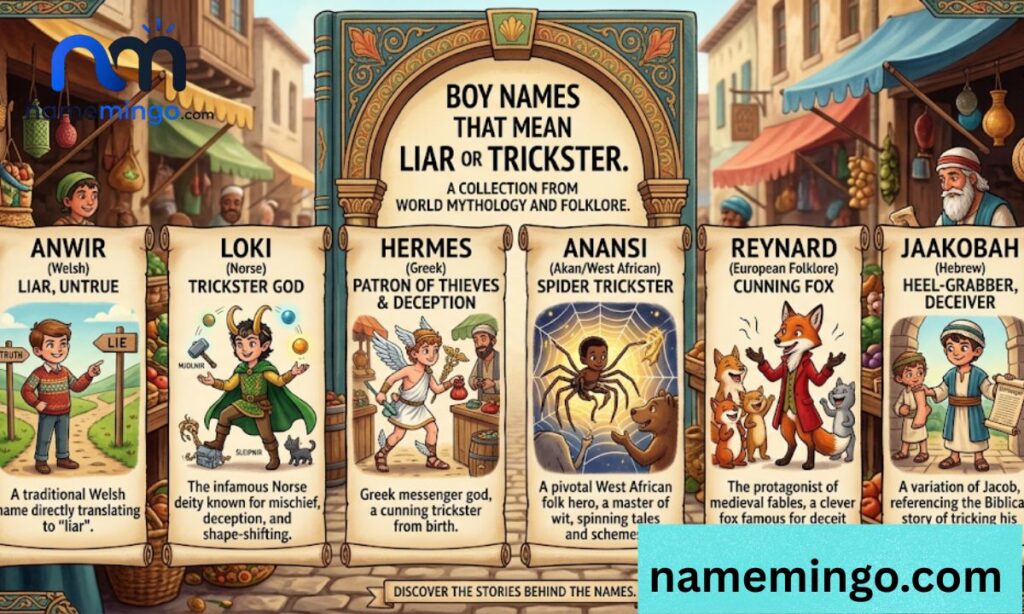
Loki : Norse trickster god, the archetype for the theme. His name is inseparable from lies and mischief.
Hermes : Messenger god whose cleverness made him a natural trickster. He balanced charm with deception effortlessly.
Coyote : Native American trickster whose schemes drive countless tales. He often lies to gain an advantage.
Raven : Pacific Northwest trickster spirit known for clever words. He uses cunning to shape the world around him.
Anansi : Spider trickster whose stories rely on wit and lies. He outsmarts stronger animals through deception.
Eshu : Yoruba trickster spirit who blurs the line between truth and lies. He tests people through confusion.
Legba : Crossroads spirit known for playful deception. He often disguises his true motives.
Maui : Polynesian trickster hero who bends truth for good causes. His tricks often carry heroic intentions.
Reynard : The definitive fox trickster of medieval fable. His cunning lies are central to his legend.
Br’er : Short form referencing Br’er Rabbit, a Southern folk trickster. He escapes danger through clever deception.
Til : Short form for Till Eulenspiegel, prankster and trickster. His lies often revealed uncomfortable truths.
Puck : Fairy trickster known for illusions and pranks. He delights in harmless but clever deception.
Wakdjunkaga : Trickster figure from Ho-Chunk tradition. His chaotic lies drive many traditional tales.
Nanabozho : Ojibwe trickster and teacher figure. He deceives while quietly guiding others toward lessons.
Sinon : Greek trickster soldier whose lie doomed Troy. His name endures as a symbol of fatal deception.
Dolos : Personification of trickery in Greek myth. His name is the literal root of deceit.
Loge : Variant tied to Loki’s fiery trickster nature. It shares his reputation for cunning.
Nick : Playful nickname tied to a trickster devil figure. It fits a mischievous, sly character.
Names That Mean Betrayer
Judas : The most recognized name tied to betrayal. His story is the defining example of a trusted friend turning traitor.
Brutus : Roman name linked to betraying Julius Caesar. His name became synonymous with betrayal by someone close.
Mordred : Arthurian figure who betrayed King Arthur. His name is tied to treachery within family bonds.
Ganelon : Betrayer from the Song of Roland. His treachery led to a legendary tragedy.
Loki : Norse god whose betrayals shaped mythic events. His lies often turned into deeper acts of treachery.
Iago : Literary betrayer whose manipulation destroyed trust. His name remains linked to calculated treason.
Delilah : Biblical figure remembered for betraying Samson’s trust. Her name carries the weight of intimate betrayal.
Jezebel : Name tied to scheming and betrayal of loyalty. It remains a strong symbol of manipulation.
Ephialtes : Greek figure who betrayed the Spartans at Thermopylae. His name is forever linked to a costly betrayal.
Cassius : Roman name tied to conspiracy against Caesar. It carries the weight of political betrayal.
Laban : Biblical figure who betrayed Jacob through broken promises. Their story is one of mutual deception.
Cain : Name tied to betraying trust within family. His story remains one of history’s earliest betrayals.
Wormtongue-style names : Modern fantasy naming often uses “tongue” or “worm” roots for betrayers. These invented names suggest whispered, poisonous treachery.
Traitorel : An invented, poetic name built on “traitor.” It suits a fictional betrayer character.
Falsor : Invented Latin-inspired name rooted in falsus (false). It fits a formal, villainous betrayer.
Perfidia : Word-inspired name from “perfidious,” meaning treacherous. It suits a dramatic, literary betrayer.
Vantor : Invented name suggesting one who turns against others. It works well in fantasy storytelling.
Renegar : Invented name echoing “renegade.” It fits a character who abandons loyalty through betrayal.
Names That Mean Manipulator
Circe : Sorceress whose enchantments controlled others’ minds. Her name is tied directly to manipulation through magic.
Iago : Literary manipulator whose words destroyed lives. His careful scheming remains the definitive fictional example.
Loki : Norse god known for manipulating events and people. His mischief often had lasting consequences.
Medea : Sorceress whose manipulation shaped tragic events. Her story shows manipulation driven by betrayal and revenge.
Delilah : Figure remembered for manipulating trust for personal gain. Her charm was the tool of her manipulation.
Jezebel : Name symbolizing calculated influence over others. It’s often used for a manipulative, scheming character.
Machiavel : Name inspired by Niccolò Machiavelli, whose ideas gave rise to the word “Machiavellian.” It suits a calculating, strategic manipulator.
Puppetta : Invented name built on “puppet,” suggesting control over others. It fits a manipulative fictional character.
Straton : Invented Greek-inspired name suggesting strategy and control. It works for a calculating manipulator.
Weaver : Word-name suggesting someone who weaves plans and people together. It fits a subtle, manipulative character.
Coerce : Word-based name rooted in forceful manipulation. It suits a dramatic villain role.
Sway : Word-name meaning to influence or manipulate. It works as a short, modern character name.
Kitsune : Fox spirit whose illusions manipulate perception. Folklore ties these spirits to subtle control over humans.
Salome : Figure remembered for manipulating through charm and request. Her story shows manipulation with deadly consequences.
Scapin : Cunning servant from classic comedy who manipulates every character around him. His schemes drive the entire plot.
Vex : Short word-name meaning to trouble or manipulate emotions. It suits a sharp, modern character.
Cassian Vale : Invented modern name suggesting cool, calculated control. It works well for a strategic manipulator.
Threnna : Invented fantasy name suggesting quiet, persuasive control. It fits a mysterious, manipulative character.
Names That Mean Secretive
Hisoka : Japanese name meaning “secretive” or “reticent.” It’s one of the more direct real-world examples of this theme.
Raz : Hebrew name meaning “secret” or “mystery.” It’s short, modern, and rooted in real meaning.
Sirri : Turkish name derived from Arabic sirr, meaning “secret.” It translates loosely to “my secret.”
Shinobi : Japanese term for a stealth agent, rooted in “to hide or endure.” It carries a strong sense of concealment.
Umbra : Latin word for “shadow.” It suggests someone who prefers to stay hidden from view.
Skuggi : Old Icelandic word meaning “shadow.” It fits a quiet, secretive character.
Enigma : Greek-rooted word meaning “riddle” or “mystery.” It’s used for characters whose true nature stays hidden.
Arcana : Latin word for “secrets” or “mysteries.” It has a mystical, hidden quality.
Cryptia : Invented name built on “cryptic.” It suggests something deliberately hard to understand.
Mysterio : Word-based name meaning “mystery” in Spanish and Italian. It leans toward theatrical secrecy.
Velia : Invented name inspired by “veil.” It suggests something gently hidden from sight.
Sequestra : Invented name rooted in Latin sequestrare, “to hide away.” It fits someone who withdraws and conceals.
Discreta : Invented Latin-style name from “discreet.” It suggests careful, quiet secrecy.
Cache : English word for a hidden store of something. As a name, it suggests hidden depths.
Secreta : Invented name built directly on “secret.” It’s simple and thematic.
Nyxandra : Invented name blending “Nyx” (night) with a secretive undertone. It suggests things hidden by darkness.
Zorai : Invented name with a hushed, whispery sound. It fits a quietly secretive character.
Confide : Word-based name from “confidential.” It suggests trust wrapped around hidden information.
Latebra : Latin word meaning “hiding place.” It’s an unusual but meaningful choice.
Occulta : Latin-rooted name meaning “hidden” or “occult.” It carries a mysterious, secretive tone.
Names That Mean Schemer
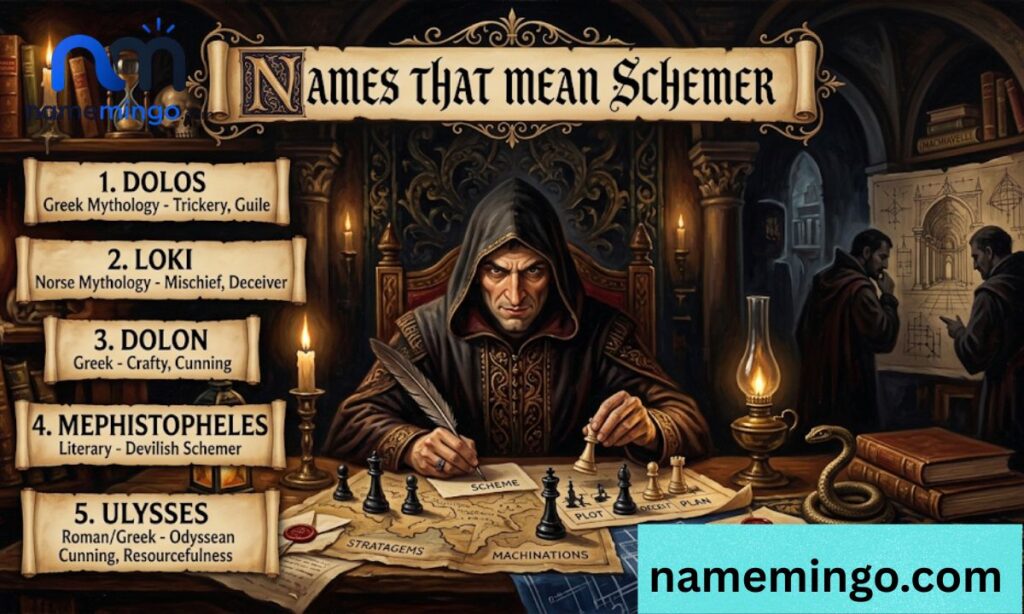
Machiavel : Name inspired by Niccolò Machiavelli, whose ideas defined political scheming. It suits a calculating strategist.
Machiavella : Feminine variant of the same root. It carries the same strategic, scheming tone.
Cabal : Word for a secretive group plotting together. As a name, it suggests coordinated scheming.
Intrigo : Italian word for “intrigue.” It fits a character who thrives on secret plots.
Conspira : Invented name rooted in Latin conspirare, “to conspire.” It suggests careful, hidden planning.
Plotina : Invented name built directly on “plot.” It suggests someone always arranging hidden schemes.
Ulterior : Word-based name from “ulterior motive.” It hints at hidden intentions behind actions.
Sceadu : Old English word for “shadow,” often tied to scheming figures. It suggests plans made out of sight.
Slynn : Invented name rooted in “sly.” It fits a quietly clever schemer.
Foxworth : Invented surname-style name built on “fox.” It suggests inherited cunning.
Ravensworth : Invented surname-style name tied to the trickster raven. It fits a calculating character.
Vantage : Word-based name meaning strategic advantage. It suits someone always planning ahead.
Straton : Greek-rooted name linked to strategos, meaning “strategist.” It fits a calculating mind.
Cunninger : Invented surname-style name playing on “cunning.” It suggests inherited scheming skill.
Designa : Invented name rooted in “design” or “designing.” It hints at carefully built plans.
Wexley : Invented name with a sly, old-world sound. It suits a quietly scheming character.
Ploy : Direct word-name meaning a scheme or tactic. It’s short, sharp, and meaningful.
Machina : Latin word meaning “device” or “scheme,” root of “machination.” It fits a calculating character.
Contriva : Invented name rooted in “contrive.” It suggests carefully engineered plans.
Snare : Word-name meaning a trap laid for someone. It fits a schemer who sets careful plans.
Also Read This : 614+ Inspiring Private & Charter School Name Ideas (2026)
Names That Mean Deception
Apate : Greek personification of deceit itself. Her name is the mythic root of the concept.
Dolos : Greek spirit whose name literally means “trickery” or “deception.” He is deception’s oldest symbol.
Mendax : Latin word meaning “lying” or “false.” It’s the direct root of “mendacious.”
Falsus : Latin word meaning “false.” It’s simple, direct, and rooted in real language.
Fraus : Latin word meaning “fraud” or “deceit.” It carries formal, legal weight.
Engaño : Spanish and Portuguese word for “deception.” It’s commonly used in folklore and literature.
Tromperie : French word meaning “deception” or “trickery.” It has an elegant, literary sound.
Betrug : German word meaning “fraud” or “deception.” It’s blunt and direct in meaning.
Inganno : Italian word meaning “deception.” It appears often in opera and classic literature.
Illusio : Latin root of “illusion.” It suggests deception built on false appearances.
Phantasia : Greek root of “fantasy” or “appearance.” It reflects deception through imagined images.
Simulacra : Latin word for a deceptive likeness or image. It suggests something that only appears real.
Pseustes : Greek word literally meaning “liar,” from pseudos (falsehood). It’s a rarely used but authentic term.
Pseudo : Greek root meaning “false.” It’s widely recognized and easy to use as a name element.
Sofisma : Word rooted in “sophism,” a deceptive argument. It suggests deception through clever reasoning.
Maya : Sanskrit word for illusion. It’s one of the most recognized real names tied to this theme.
Vana : Word meaning “vain” or “empty.” It suggests deception without real substance.
Falsario : Spanish and Italian word for “forger” or “counterfeiter.” It fits someone who deceives through fakery.
Deceptra : Invented feminine name built directly on “deception.” It’s modern and thematic.
Charlatan : English word from French, meaning someone who deceives through false claims. It’s a strong, recognizable choice.
Names That Mean Trickster in Japanese
Kitsune : Fox spirit famous for illusions and shapeshifting. Folklore says kitsune trick humans by taking human form.
Tanuki : Raccoon dog spirit known for playful trickery. Stories describe tanuki using shapeshifting to fool travelers.
Itazura : Japanese word meaning “mischief” or “prank.” It’s used to describe playful, harmless trickery.
Sagi : Japanese word meaning “fraud” or “swindle.” It’s a direct, real-world term for deception.
Uso : Japanese word that simply means “lie.” It’s one of the most direct examples of this theme.
Damashi : Rooted in the verb damasu, “to deceive.” It reflects the act of trickery itself.
Bakemono : General term for a shapeshifting monster or trickster spirit. These figures often deceive through disguise.
Mujina : Shapeshifting badger spirit known for trickery. Folklore says mujina can disguise themselves as humans.
Tengu : Mountain goblin spirit known for mischief and trickery. Tales describe tengu misleading travelers in the mountains.
Karasu Tengu : Crow-like variant of the tengu spirit. It’s associated with cunning and aerial trickery.
Susanoo : Shinto storm god known for mischief and chaos. His impulsive tricks caused trouble among the gods.
Nue : Chimera-like yokai with a deceptive, shifting nature. It’s often described as bringing misfortune through illusion.
Yamamba : Mountain witch known for deceiving travelers. She often disguises her true, dangerous nature.
Hengeyokai : General term for shapeshifting trickster spirits. These beings use disguise to deceive humans.
Zashiki-warashi : Mischievous child spirit from Japanese folklore. It’s known for playful, sometimes unsettling pranks.
Kappa : River spirit known for mischief and trickery. Kappa often lure people near water with clever tricks.
Kitsunebi : Term for “fox-fire,” a ghostly illusion linked to fox spirits. It represents deception through false light.
Henge : Root word meaning “transformation” or “shapeshifting.” It reflects the core trickster ability of disguise.
Bakeneko : Shapeshifting cat spirit known for trickery. Stories describe bakeneko deceiving their owners after transformation.
🕵️ Last Names That Mean Liar
Fox : English surname long associated with cunning. It reflects the folk symbolism of the clever, tricky fox.
Todd : Old English word for “fox,” used as a surname. It carries the same cunning symbolism.
Renard : French surname meaning “fox.” It became a lasting symbol of trickery through folklore.
Lupin : French-rooted surname meaning “wolf-like.” It’s famously tied to a fictional gentleman thief known for deception.
Sly : Surname meaning cunning or crafty. It’s a direct, simple choice for this theme.
Wylie : Scottish surname meaning “cunning” or “crafty.” It shares roots with the word “wily.”
Fuchs : German surname meaning “fox.” It reflects the same cunning symbolism found across cultures.
Vos : Dutch surname meaning “fox.” It’s a short, simple nod to trickster symbolism.
Lisitsyn : Russian surname rooted in lisa, meaning “fox.” It reflects Slavic fox-trickster folklore.
Craft : English surname tied to skill and cunning. It suggests careful, crafted deception.
Guile : Surname-style name meaning calculated deceit. It fits a formal, literary tone.
Machiavelli : Historical Italian surname associated with cunning and manipulation. It gave rise to the word “Machiavellian.”
Quisling : Norwegian surname that became a lasting symbol of betrayal. It comes from a real historical figure known for treachery.
Falsari : Italian-style surname meaning “forger.” It fits a character who deceives through fakery.
Cunningham : Scottish surname sometimes folk-linked to “cunning” through sound, though its true origin differs. It’s a popular pick for this theme regardless.
Slyman : Invented surname combining “sly” with “man.” It’s simple and thematic.
Trickham : Invented surname built on “trick.” It suits a playful, deceptive character.
Deceivere : Invented, stylized surname built on “deceive.” It fits fantasy or fictional use.
Foxwell : Invented English-style surname blending “fox” with a place-name ending. It carries a subtle trickster nod.
Mythological & Legendary Names Associated with Deception
Loki : Norse trickster god whose lies shaped major myths. He remains the most iconic mythological deceiver.
Circe : Greek sorceress whose enchantments deceived travelers. She’s remembered for transforming Odysseus’s men.
Medea : Sorceress whose cunning and betrayal shaped tragic myths. Her story blends deception with revenge.
Eris : Goddess of discord whose golden apple sparked conflict. Her trick remains one of mythology’s most famous.
Ate : Goddess of delusion and mischief. She clouds judgment, leading others toward false choices.
Hermes : Messenger god known for charm and clever lies. He deceived his way out of trouble as an infant.
Prometheus : Titan who tricked the gods to help humanity. His deception permanently changed mortal history.
Sinon : Greek soldier whose false story doomed Troy. His lie is one of mythology’s most consequential.
Autolycus : Greek trickster known as “the wolf itself.” He was famous for lies and clever theft.
Anansi : West African spider trickster known for clever deception. His stories often teach lessons through lies.
Coyote : Native American trickster whose schemes drive countless tales. He often lies to gain an advantage.
Raven : Trickster spirit from Pacific Northwest legend. He uses cunning words to shape events.
Legba : West African and Vodou crossroads spirit. He often uses deception to test people’s honesty.
Eshu : Yoruba trickster spirit who blurs truth and lies. His tricks reveal hidden truths through confusion.
Maui : Polynesian trickster hero who bends truth for good. His tricks often carry heroic intentions.
Melinoe : Greek goddess linked to ghostly, deceptive visions. She represents illusion born from darkness.
Scylla : Sea monster tied to deceptive danger. Sailors were lured by false safety near her waters.
Lorelei : Siren of Rhine folklore who lured sailors with song. Her call promised comfort but led to danger.
Baba Yaga : Witch of Slavic folklore known for riddles and trickery. She often deceived visitors who entered her domain.
Literary & Historical Names Symbolizing Deception
Iago : Shakespeare’s calculating villain from Othello. His manipulation remains literature’s defining example of deceit.
Wormtongue : Deceptive advisor from The Lord of the Rings. His whispered lies slowly corrupted those around him.
Uriah Heep : Character from David Copperfield known for false humility. His fake modesty hid a deeply manipulative nature.
Becky Sharp : Manipulative schemer from Vanity Fair. She uses charm and deception to climb through society.
Cathy Ames : Manipulative figure from East of Eden. Her deceptive nature drives much of the novel’s tragedy.
Fagin : Deceptive manipulator from Oliver Twist. He uses charm and lies to control the children around him.
Claudius : Betrayer and deceiver from Hamlet. His hidden crime sets the entire tragedy into motion.
Brutus : Historical and literary figure tied to betraying Julius Caesar. His name symbolizes betrayal by someone trusted.
Cassius : Roman conspirator against Caesar. His scheming helped drive one of history’s most famous betrayals.
Judas Iscariot : Historical and biblical figure remembered for ultimate betrayal. His name remains synonymous with a trusted friend turned traitor.
Machiavelli : Historical political theorist whose ideas gave rise to “Machiavellian” scheming. His name symbolizes calculated manipulation.
Talleyrand : Historical French diplomat famous for cunning duplicity. He was known for shifting loyalties throughout his career.
Quisling : Historical Norwegian figure whose name became a lasting symbol of betrayal. It’s now used generally to mean “traitor.”
Benedict Arnold : Historical American figure remembered for infamous betrayal. His name remains a lasting symbol of treachery.
Mata Hari : Historical figure associated with espionage and deception. Her story blends mystery with real historical intrigue.
Long John Silver : Deceptive pirate from Treasure Island. His charm hides a calculating, self-serving nature.
Tom Ripley : Deceptive con artist from The Talented Mr. Ripley. He builds his entire identity on layered lies.
Sinon : Deceptive figure from Virgil’s Aeneid. His false story helped bring down the city of Troy.
Ganelon : Betrayer from the Song of Roland. His treachery led to a legendary medieval tragedy.
Also Read This : 584 +Utopian City Names: Ideas for Futuristic, Fantasy & Sci Fi Worlds
Names Inspired by Trickery, Lies, or Cunning
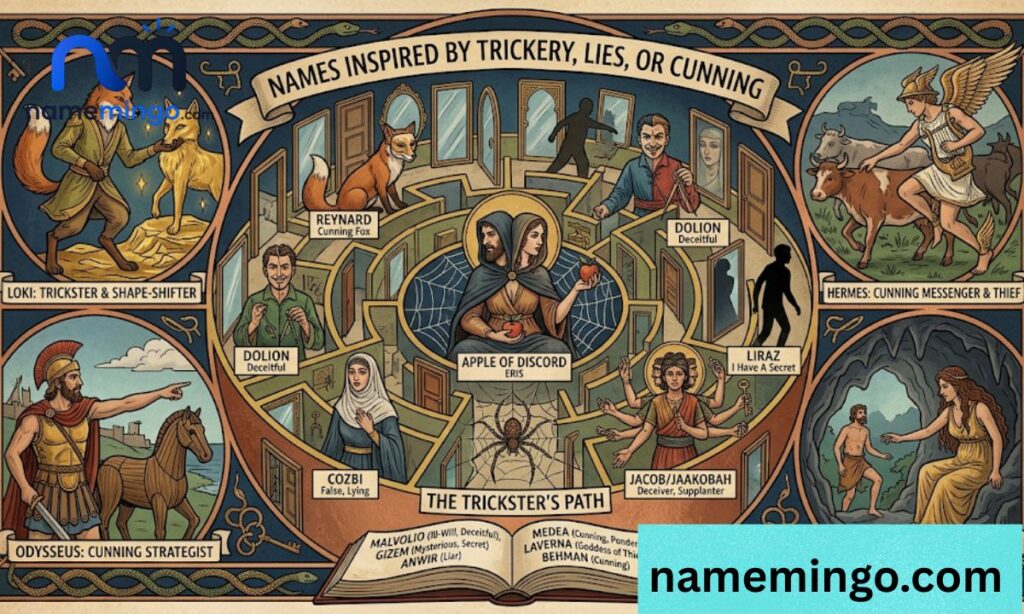
Guile : Word-name meaning calculated, clever deceit. It suits a sharp, scheming character.
Wile : Word-name meaning a cunning trick. It fits someone who deceives through clever plans.
Ruse : Direct word-name meaning a crafty trick. It’s short, sharp, and easy to use.
Feint : Word-name meaning a deceptive move meant to mislead. It fits a quick-thinking, tactical character.
Bluff : Word-name meaning a confident, deceptive front. It suits a bold, risk-taking character.
Artifice : Word-name meaning clever trickery or deception. It has a refined, literary quality.
Subterfuge : Word-name meaning deceit used to achieve a goal. It fits a careful, strategic character.
Sleight : Word-name rooted in “sleight of hand.” It suggests deception through skillful misdirection.
Craft : Word-name suggesting skillful, careful deception. It fits a patient, calculating character.
Vixen : Word tied to a female fox, symbolizing cunning. It’s often used for a clever, sly character.
Foxglove : Nature-inspired name blending “fox” with a delicate flower. It suggests cunning hidden behind beauty.
Rook : Word-name from the verb “to rook,” meaning to swindle. It also nods to the clever chess piece.
Gull : Word-name from the archaic verb “to gull,” meaning to deceive. It’s short and rooted in real language.
Con : Short word-name from “con artist.” It’s direct and instantly recognizable.
Ploy : Word-name meaning a scheme or tactic. It’s simple, sharp, and thematic.
Cunning : Direct word-name meaning clever deceit. It’s bold and unmistakably tied to the theme.
Wily : Word-name meaning sly and cunning. It’s playful yet clearly meaningful.
Sly : Word-name meaning cunning or crafty. It remains one of the simplest, most direct choices.
Snare : Word-name meaning a trap laid for someone. It fits a calculating, patient character.
Modern & Pop Culture Names Associated With Deception
Loki : The MCU’s version of the Norse trickster god. His modern popularity keeps deception themes alive in pop culture.
Tom Ripley : Deceptive antihero from modern film and fiction. He remains a defining pop-culture con artist.
Amy Dunne : Manipulative character from Gone Girl. Her calculated deception drives the story’s biggest twists.
Walter White : Character from Breaking Bad built around deception. His double life defines the show’s central tension.
Frank Underwood : Manipulative politician from House of Cards. His scheming defines the show’s entire narrative style.
Cersei Lannister : Schemer from Game of Thrones known for manipulation. Her plots shape much of the series’ conflict.
Petyr Baelish : Master manipulator from Game of Thrones. His quiet scheming influences events across the entire story.
Light Yagami : Deceptive genius from Death Note. His hidden identity drives the show’s central conflict.
Sylvie : Variant trickster figure from the Loki series. She embodies rebellion through clever deception.
The Joker : Iconic figure associated with chaos and deception. His unpredictable lies define much of his character.
Keyser Söze : Legendary deceiver from The Usual Suspects. His hidden identity remains one of film’s most famous twists.
Tyler Durden : Character from Fight Club built around a hidden deception. His true nature reshapes the entire story.
Gollum : Deceptive, manipulative figure from The Lord of the Rings. His duplicity is central to his tragic character.
Dolores Umbridge : Deceptively cruel figure from the Harry Potter series. Her false sweetness hides harmful intentions.
Mystique : Shape-shifting deceiver from the X-Men universe. Her literal transformation embodies the trickster theme.
Regina George : Manipulative character from Mean Girls. Her social scheming defines the film’s central conflict.
Scar : Deceptive villain from The Lion King. His manipulation drives the story’s core betrayal.
Ursula : Deceptive sea witch from The Little Mermaid. Her bargain hides a manipulative true intention.
Iago : Mischievous parrot from Aladdin, named after Shakespeare’s deceiver. It’s a playful modern nod to the classic theme.
Nature & Symbolic Names Reflecting Deception
Fox : Long-standing symbol of cunning across many cultures. It remains the clearest natural symbol of trickery.
Chameleon : Symbol of disguise through changing colors. It reflects deception through constant adaptation.
Mockingbird : Known for mimicking other sounds convincingly. Its mimicry represents deception through imitation.
Bee Orchid : Flower that mimics a bee to attract pollinators. Its deceptive appearance is a true natural trick.
Anglerfish : Deep-sea fish that lures prey with false light. Its glowing lure represents deception as survival.
Mimic Octopus : Sea creature famous for imitating other animals. It uses disguise as a defense and hunting tool.
Viceroy : Butterfly that mimics the Monarch to avoid predators. Its resemblance is a clever survival deception.
Cuckoo : Bird known for laying eggs in other nests. It deceives host birds into raising its young.
Venus Flytrap : Plant that lures insects with a deceptive appearance. Its trap closes only once prey is fooled.
Penumbra : Word for a partial shadow between light and dark. It suggests deception hidden in half-truths.
Mirage : Natural illusion often seen in deserts. It represents hope or truth that isn’t really there.
Smoke : Symbol tied to the phrase “smoke and mirrors.” It suggests truth obscured by distraction.
Fog : Natural symbol of hidden, unclear truth. It reflects deception through concealment rather than lies.
Serpent : Cultural symbol of deception across many traditions. Its association with trickery spans myth and religion.
Spider : Symbol of patient, calculated deception through webs. It ties closely to trickster figures like Anansi.
Moth : Drawn helplessly toward false, flickering light. It symbolizes being led astray by illusion.
Wolf : Tied to the idiom “a wolf in sheep’s clothing.” It represents hidden danger behind a deceptive disguise.
Owl : Symbol of hidden wisdom and nighttime secrecy. Its quiet nature ties it to concealment and mystery.
Raven : Trickster bird tied to cunning across many cultures. It blends natural symbolism with mythological deception.
How We Curate Names That Mean Liar or Trickster
Every name on this list is chosen with care, blending real linguistic roots, mythology, folklore, and creative interpretation. Wherever a meaning comes from an authentic source like Hebrew, Latin, Japanese, or Greek that origin is noted so readers know it’s grounded in real language.
For themes without many direct dictionary matches, invented or word-inspired names are included and clearly framed as creative rather than literal. This keeps the list useful for writers, fans of mythology, and anyone curious about naming traditions, without presenting guesswork as fact.
Names are also grouped by tone and source, from ancient myth to modern pop culture, so readers can quickly find a name that fits the specific style or story they have in mind.
Tips for Choosing a Trickster or Liar Themed Name
Start with the story you want the name to tell. A mythological name like Loki carries very different weight than a modern pop-culture pick like Amy Dunne.
Pay attention to origin and language, especially if the name will be used respectfully in fiction, gaming, or worldbuilding tied to a real culture.
Think about subtlety versus obviousness. A name like “Deceptra” announces its meaning clearly, while “Raz” or “Hisoka” hides it more quietly.
Consider how the name sounds out loud, since a strong theme still needs to feel natural and pleasant in everyday use or storytelling.
Finally, blend categories if needed. A character can pull from mythology for depth and a modern nickname for accessibility, giving the name more than one layer of meaning.
Frequently Asked Questions
What name means “liar”?
Loki is a well-known name that means trickster or liar in Norse mythology.
Is there a girl name that means deceiver?
Yes, Delilah is often linked to the meaning “deceptive” or “delicate deceiver.”
What boy name means “cunning”?
Reynard means “cunning” or “fox-like,” often tied to trickery.
Are there names meaning “trickster”?
Yes, Loki and Puck both carry the meaning “trickster.”
What does the name Delilah really mean?
Delilah means “delicate” but is famously tied to betrayal and deception.
Do any names mean “deceptive” in a good way?
Some parents choose these names for their mythic charm, not literal meaning.
Conclusion
Names with hidden meanings like “liar” or “deceiver” carry a special charm. They connect us to old myths and stories. Choosing one adds mystery to a name.
These names are not about bad character. They show creativity and depth. A unique meaning can make a name unforgettable.

Daniel is the creator of Namemingo.com, a writer guided by curiosity and a deep passion for the stories behind names. With a background in linguistics, cultural history, and name etymology, Daniel transforms complex research into clear, engaging, and easy-to-understand content. His writing invites readers to explore the rich origins, spiritual meanings, and cultural significance hidden within everyday names.