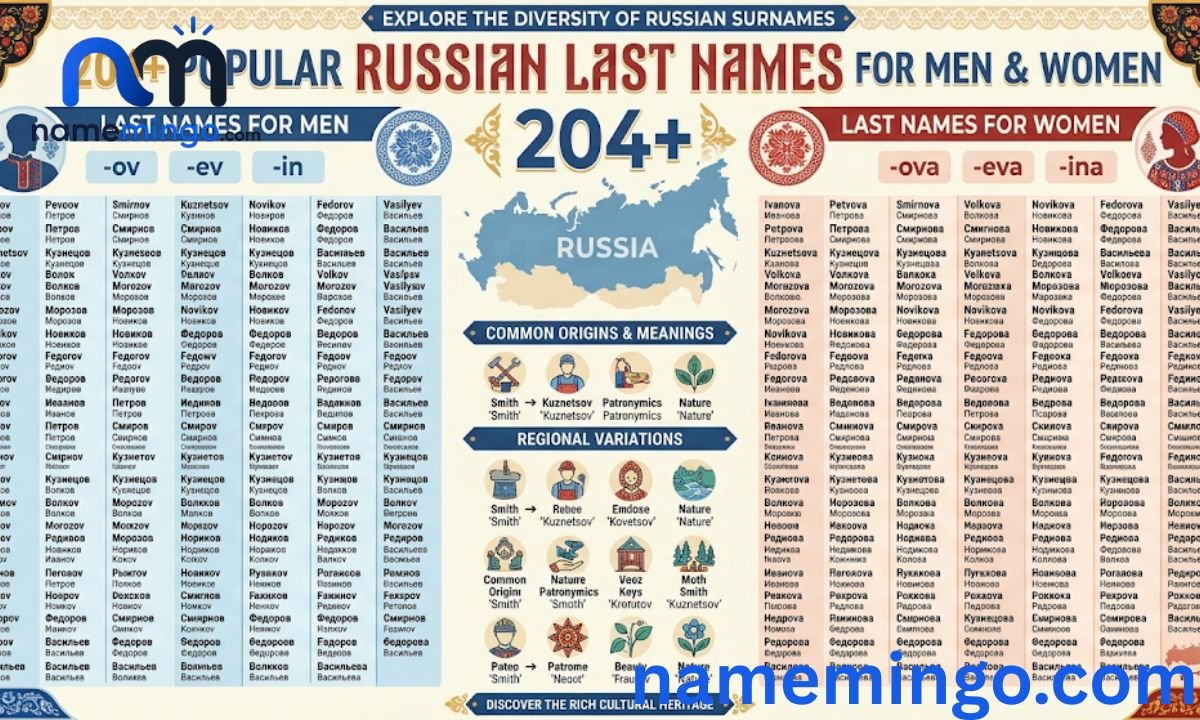
Russian last names are easy to spot. Many of them end in “-ov,” “-ev,” or “-in” for men. Women get the same name with an “-a” at the end. So Ivanov becomes Ivanova, and Smirnov becomes Smirnova.
Some names are very common across Russia. Ivanov, Smirnov, Kuznetsov, and Popov are at the top of the list. Many of these names came from jobs, like Kuznetsov, which means “blacksmith.” Others came from a father’s first name, like Petrov, which means “son of Peter.”
Knowing these patterns makes Russian names much easier to understand. You can often tell a person’s gender just by the ending. You can also guess where the name came from. It is a small but fun peek into Russian history and culture.
The History and Origins of Russian Surnames
Russian surnames began to appear in the 14th and 15th centuries, first among nobles and landowners. Many came from place names, family estates, or a father’s name. Ordinary people only got fixed surnames much later.
- Shuisky : from the town of Shuya
- Obolensky : from the town of Obolensk
- Golitsyn : from a nickname meaning “iron glove”
- Trubetskoy : from the town of Trubchevsk
- Gagarin : from a nickname linked to “gagara,” a type of bird
- Sheremetev : from an old Turkic-origin nickname
- Romanov : from the ancestor Roman Yuryev
- Godunov : from a Tatar-origin ancestor’s name
- Pozharsky : from the village of Pozhar
- Yusupov : from the Tatar ruler Yusuf
- Dolgorukov : from the nickname “long-armed”
- Vorontsov : from an ancestor nicknamed “Voronets” (raven)
Most Common Russian Family Names
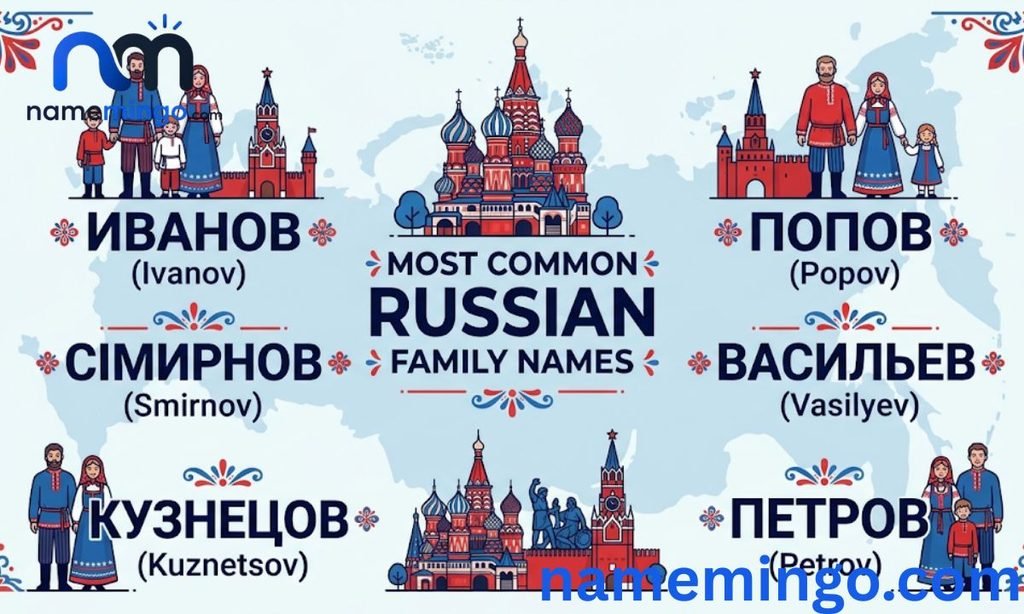
Some surnames are so common that millions of Russians share them. They usually come from first names, jobs, or simple nicknames. You will meet these names in every Russian city.
- Ivanov : son of Ivan
- Smirnov : from “smirny,” meaning quiet or calm
- Kuznetsov : son of the blacksmith
- Popov : son of the priest
- Sokolov : from “sokol,” meaning falcon
- Lebedev : from “lebed,” meaning swan
- Kozlov : from “kozel,” meaning goat
- Novikov : from “novik,” meaning newcomer
- Morozov : from “moroz,” meaning frost
- Petrov : son of Peter
- Volkov : from “volk,” meaning wolf
Traditional Russian Surnames and Their Meanings
Many old Russian surnames tell you what an ancestor did for a living. Each name is like a small label from a village long ago. Knowing the trade makes the meaning clear.
- Melnikov : miller
- Rybakov : fisherman
- Goncharov : potter
- Plotnikov : carpenter
- Portnov : tailor
- Bondarenko : descendant of a barrel maker
- Kovalev : smith
- Tkachev : weaver
- Sapozhnikov : shoemaker
- Pekarev : baker
- Stolyarov : joiner
Russian Last Names with Dark Meanings
A few Russian surnames come from harsh or gloomy words. Some were old nicknames meant to protect a child from evil spirits. Others simply described a hard life.
- Zlobin : from “zloy,” meaning evil or angry
- Chertkov : from “chert,” meaning devil
- Besov : from “bes,” meaning demon
- Mertvago : from “mertvy,” meaning dead
- Nechayev : meaning unexpected or unwanted
- Smertin : from “smert,” meaning death
- Zhadov : from “zhadny,” meaning greedy
- Pogibelev : from “pogibel,” meaning doom
- Mogilin : from “mogila,” meaning grave
- Gorin : from “gore,” meaning grief
- Likhodeev : meaning wrongdoer
ALSO READ THIS : 310+ Powerful Names That Mean Destroyer (With Origins & Meanings)
Popular Russian Last Names for Men
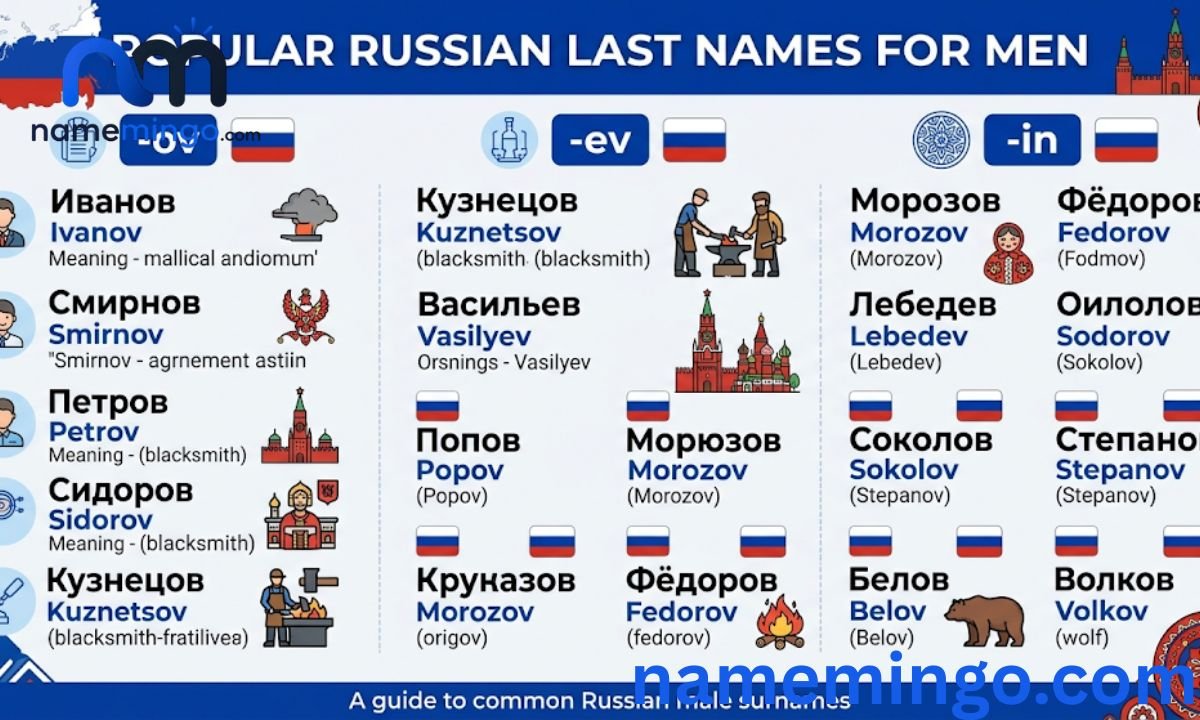
Male surnames often end in “-ov,” “-ev,” or “-in.” Most come from the father’s first name. These are some of the best-known examples.
- Pavlov : son of Pavel
- Fedorov : son of Fyodor
- Mikhailov : son of Mikhail
- Alexandrov : son of Alexander
- Semyonov : son of Semyon
- Vasiliev : son of Vasily
- Nikolaev : son of Nikolai
- Andreev : son of Andrei
- Makarov : son of Makar
- Egorov : son of Yegor
- Stepanov : son of Stepan
Russian Last Names for Women
Women usually take the male surname and add an “-a.” Names ending in “-ov” become “-ova,” and names ending in “-in” become “-ina.” Here are some common female forms.
- Nikitina : from Nikita
- Zakharova : from Zakhar
- Titova : from Tit
- Belova : from “bely,” meaning white
- Gromova : from “grom,” meaning thunder
- Davydova : from David
- Frolova : from Frol
- Filippova : from Philip
- Kiseleva : from “kisel,” a sweet fruit drink
- Tarasova : from Taras
- Antonova : from Anton
Russian Last Names Starting with K
The letter K gives us many strong and familiar Russian surnames. Some are royal, some are old trades, and some are plain nicknames. They are easy to spot in any list.
- Kalinin : from “kalina,” the guelder rose
- Karpov : from Karp, or the carp fish
- Kirillov : son of Kirill
- Klimov : son of Klim
- Kondratyev : son of Kondrat
- Korolev : from “korol,” meaning king
- Kovalenko : son of the smith
- Krylov : from “krylo,” meaning wing
- Kuzmin : son of Kuzma
- Kruglov : from “kruglyy,” meaning round
- Kudryavtsev : from “kudryavy,” meaning curly-haired
- Kochetov : from “kochet,” meaning rooster
ALSO READ THIS : 292+Unique Marathi Group Names (With Meanings) for Every Team
Rare and Unique Russian Family Names
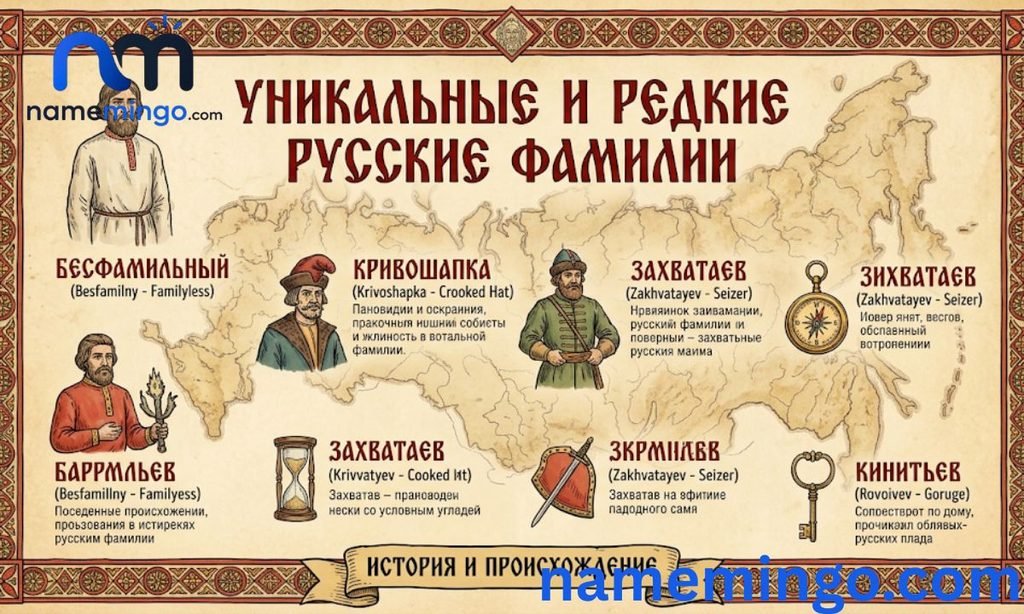
Not every Russian surname is common. Some are rare, and many are linked to famous writers, artists, and scientists. These names stand out when you hear them.
- Zhukovsky : famous poet’s surname
- Pugachev : linked to the rebel leader Pugachev
- Shalyapin : famous opera singer’s surname
- Ulyanov : the family name of Lenin
- Yesenin : famous poet’s surname
- Mendeleev : the chemist who created the periodic table
- Rakhmaninov : famous composer’s surname
- Tsvetaev : famous poet’s surname
- Shcherbakov : from “shcherbaty,” meaning gap-toothed
- Yaroslavtsev : from the city of Yaroslavl
- Ozerov : from “ozero,” meaning lake
Russian Surnames Inspired by Nature and Animals
Nature gave Russians a rich supply of surnames. Birds, beasts, trees, and plants were all used as family names. Many began as nicknames for people who looked or acted like the animal.
- Orlov : eagle
- Zaytsev : hare
- Medvedev : bear
- Vorobyov : sparrow
- Solovyov : nightingale
- Golubev : dove
- Voronov : raven
- Lisitsyn : fox
- Gusev : goose
- Zhuravlev : crane
- Berezin : birch tree
- Dubov : oak tree
Noble and Aristocratic Russian Family Names
Many of Russia’s oldest noble families took their names from the lands they ruled. Some descended from medieval princes, while others rose through service to the tsars. These names carry a strong sense of rank and history.
- Volkonsky
- Vorontsov
- Vyazemsky
- Vasilchikov
- Velyaminov
- Vrangel
- Vsevolozhsky
- Vorotynsky
- Voeikov
- Volynsky
- Vadbolsky
- Vorontsov-Dashkov
- Vonlyarlyarsky
- Valuev
- Vyrubov
ALSO READ THIS : 414+ Names That Mean Crow: Cool, Gothic, and Mythological Ideas
Uncommon Russian Last Names
Not every V surname is easy to find. These names are rare today and often come from small towns or old nicknames. You may only meet them in old records or family histories.
- Vakhrushev
- Varakin
- Vazhin
- Vdovin
- Vetlugin
- Vikharev
- Vodopyanov
- Vologdin
- Vorfolomeev
- Vozdvizhensky
- Vyunov
- Vasyutin
- Vanin
- Vodovozov
- Veniaminov
Russian Surnames With Historical Significance
Some surnames became famous because of the people who carried them. Scientists, artists, poets, and military leaders all made these names known around the world. Each one is tied to an important moment in Russian history.
- Vavilov
- Vernadsky
- Vysotsky
- Vrubel
- Vasnetsov
- Vereshchagin
- Vatutin
- Vyshinsky
- Voznesensky
- Vlasov
- Vasilevsky
- Vinogradov
- Vvedensky
- Veselovsky
- Voroshilov
How Russian Last Names Differ for Men and Women
In Russian, a surname changes form depending on gender. A man’s name usually ends in a consonant, and a woman’s name adds “-a.” Here are some pairs, with the male form first.
- Vasiliev / Vasilieva
- Volkov / Volkova
- Vorobyov / Vorobyova
- Voronin / Voronina
- Vasin / Vasina
- Vetrov / Vetrova
- Veselov / Veselova
- Vinokurov / Vinokurova
- Viktorov / Viktorova
- Vladimirov / Vladimirova
- Volodin / Volodina
- Voronov / Voronova
- Vishnyakov / Vishnyakova
- Vikulov / Vikulova
- Vyalov / Vyalova
Understanding Russian Surname Endings
The ending of a Russian surname often tells you how it was formed. The endings “-ov,” “-ev,” and “-in” usually mean “belonging to,” while “-sky” points to a place. Here are examples of each type.
- Vostrikov (-ov)
- Volchkov (-ov)
- Vedeneev (-ev)
- Vyrypaev (-ev)
- Verevkin (-in)
- Vyatkin (-in)
- Vilenkin (-in)
- Vershinin (-in)
- Verbitsky (-sky)
- Vitebsky (-sky)
- Verkhovsky (-sky)
- Vlasenko (-enko)
- Vasilenko (-enko)
- Volkovich (-ovich)
ALSO READ THIS : 400+ Inspiring Baby Names That Mean Faith for Boys and Girls
Regional Differences in Russian Family Names
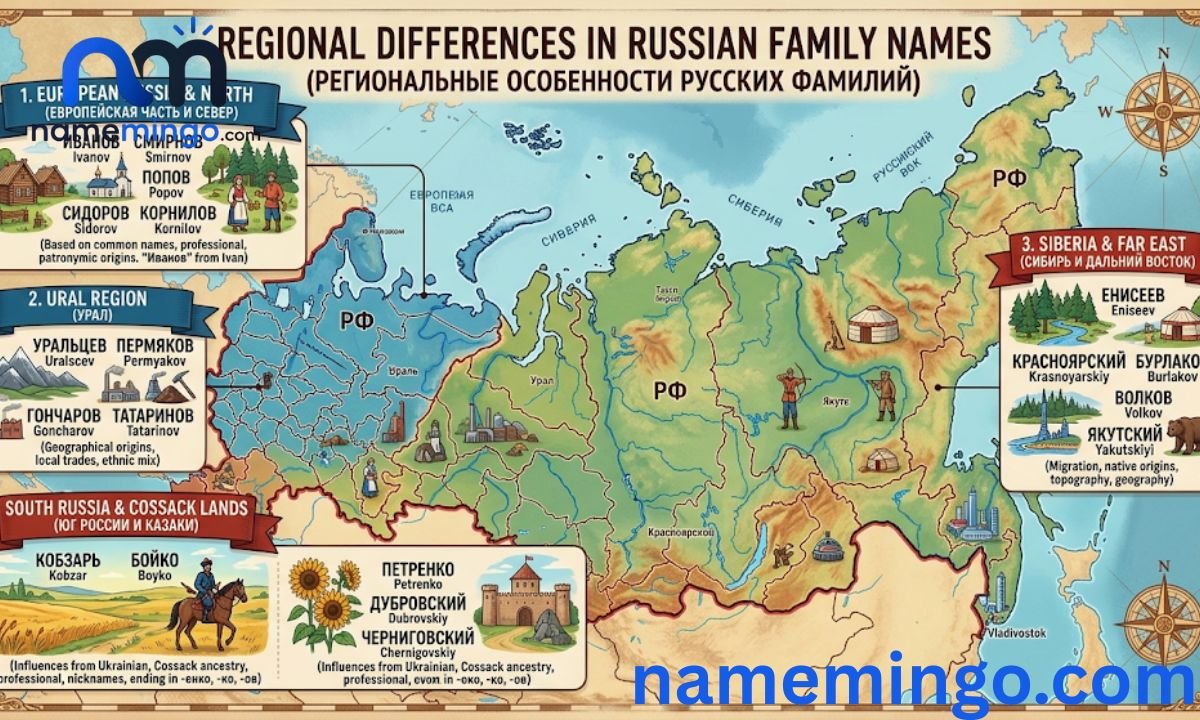
Surnames change from one region to another. Northern Russia often has names tied to rivers and towns, while Ukrainian-influenced areas favor endings like “-enko” and “-chuk.” These names show how local culture shaped each family name.
- Volgin
- Voloshin
- Vologzhanin
- Voronezhsky
- Vladimirtsev
- Vyazemtsev
- Vychegzhanin
- Vetluzhsky
- Vasylchenko
- Vovk
- Vovchuk
- Vernyhora
- Vyshnevsky
- Vinnik
How Russian Surnames Are Passed Down Through Generations
A Russian surname usually passes from father to children, with the ending adjusted for daughters. Many names began as a father’s first name and then stuck to the whole family. Over time, they became fixed family names.
- Valentinov
- Vitaliev
- Vyacheslavov
- Vsevolodov
- Valerianov
- Vikentiev
- Vasyukov
- Varlamov
- Vavilin
- Vedernikov
- Varvarin
- Vikulin
- Vlasyev
- Vasilkov
Frequently Asked Questions
What is the most common Russian last name?
Ivanov is the most common. It means “son of Ivan.”
Why do Russian last names end in -ov or -ova?
The ending means “belonging to.” Men use “-ov” and women use “-ova.”
What do Russian last names mean?
Most come from first names, jobs, places, or nicknames. Kuznetsov means “blacksmith,” and Volkov means “wolf.”
How do Russian last names change for women?
A woman adds “-a” to the male form. Petrov becomes Petrova.
What is a typical Russian last name for a man?
Names like Ivanov, Smirnov, and Popov are typical. Most end in “-ov,” “-ev,” or “-in.”
What are some beautiful Russian last names?
Romanov, Volkonsky, and Orlov sound elegant. Many also have strong meanings.
What is the rarest Russian last name?
It is hard to say for sure. Names like Vetlugin and Vazhin are very uncommon.
Do Russian last names come from nobles?
Some do. Names like Obolensky and Trubetskoy came from noble families and their lands.
What does the ending -sky mean in Russian names?
It usually points to a place or a family estate. Verkhovsky is one example.
Do Russian women keep their last name after marriage?
Many take their husband’s surname. Some keep their own or use both.
What is the difference between a surname and a patronymic?
A surname is the family name. A patronymic comes from the father’s first name, like Ivanovich or Ivanovna.
Are Russian and Ukrainian last names the same?
They are similar, but not identical. Ukrainian names often end in “-enko” or “-chuk.”
Conclusions
Russian last names tell a story. They come from first names, jobs, places, and nature. Each name holds a small piece of history. Even a simple name like Ivanov has a clear meaning.
The endings make these names easy to learn. Men use “-ov,” “-ev,” or “-in,” and women add “-a.” Once you know the pattern, you can read almost any Russian name. It is a fun way to explore the culture.

Daniel is the creator of Namemingo.com, a writer guided by curiosity and a deep passion for the stories behind names. With a background in linguistics, cultural history, and name etymology, Daniel transforms complex research into clear, engaging, and easy-to-understand content. His writing invites readers to explore the rich origins, spiritual meanings, and cultural significance hidden within everyday names.